
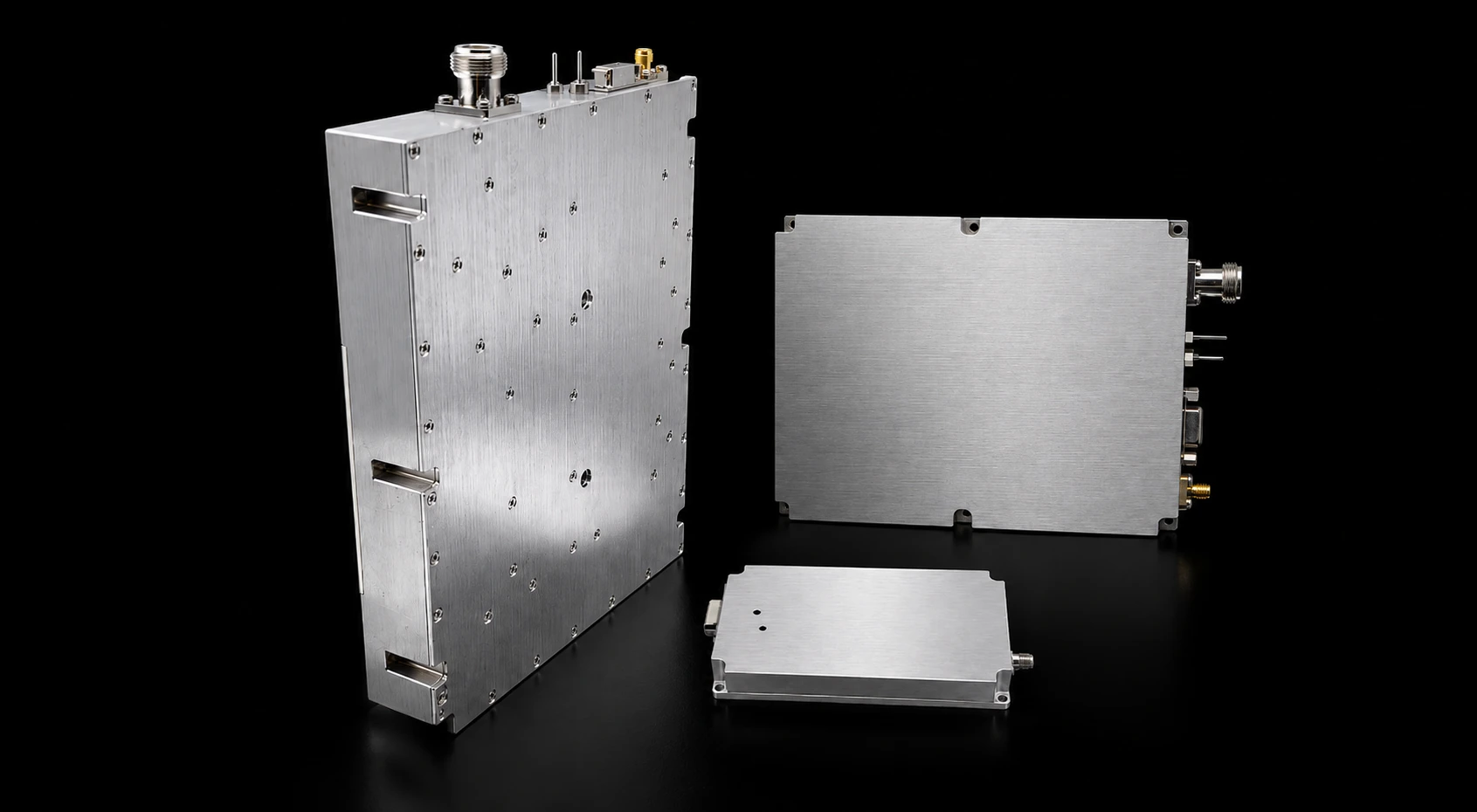
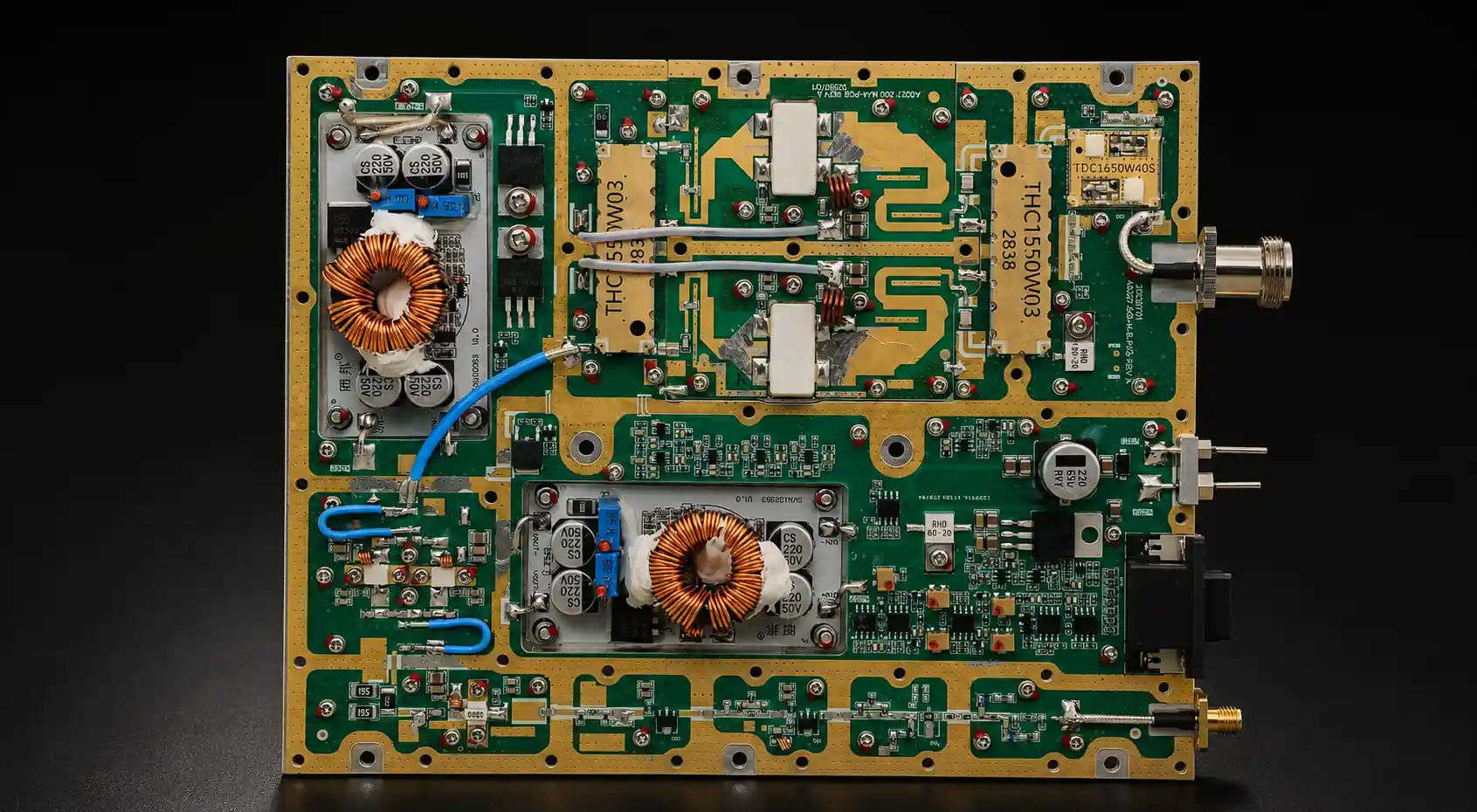
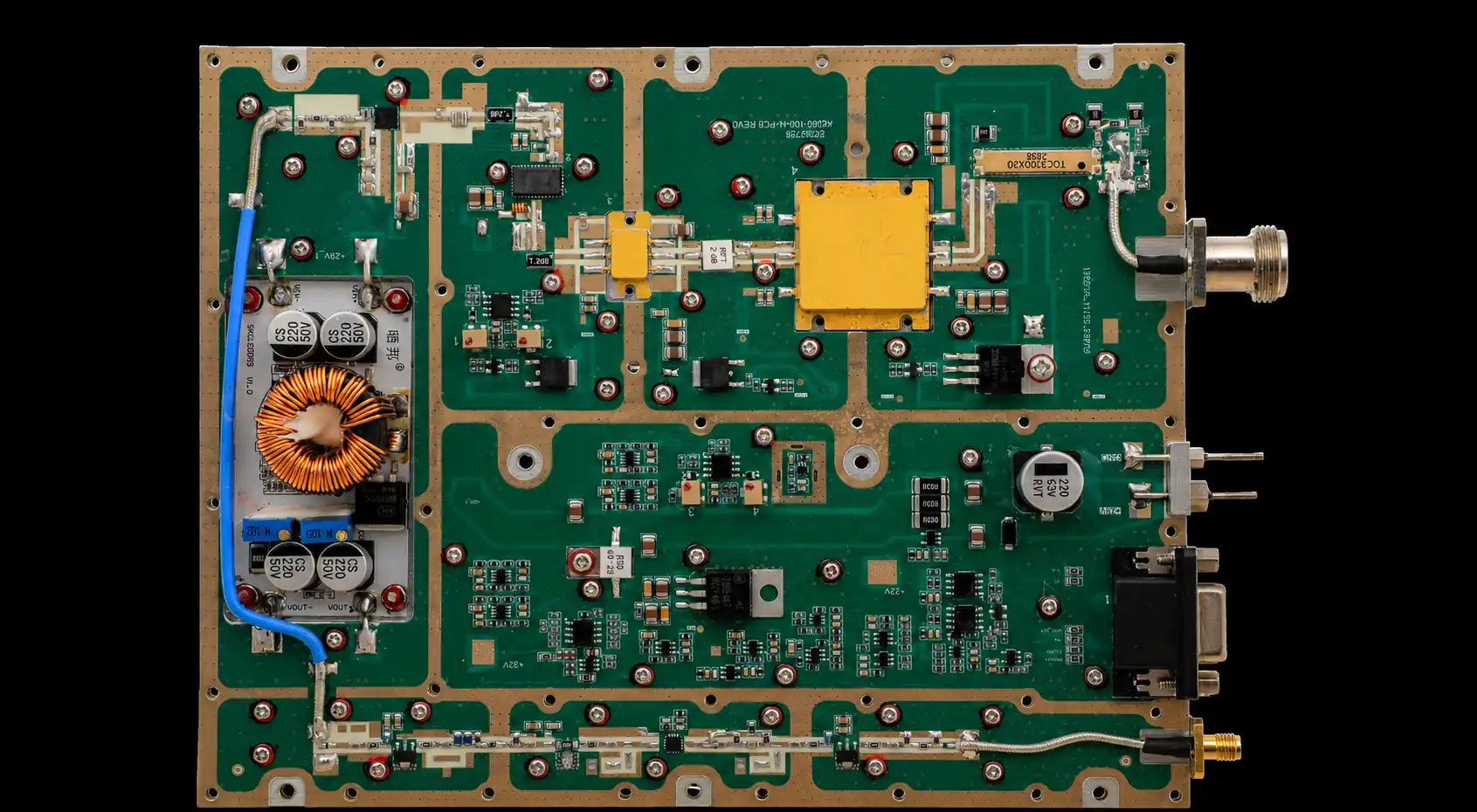
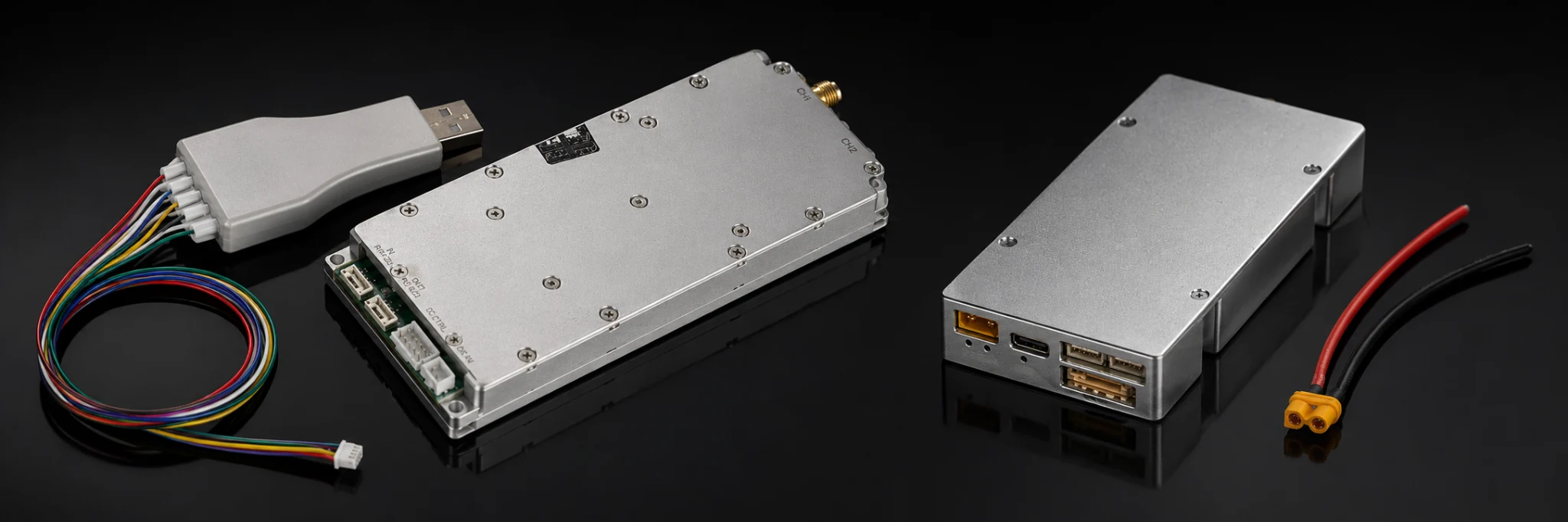

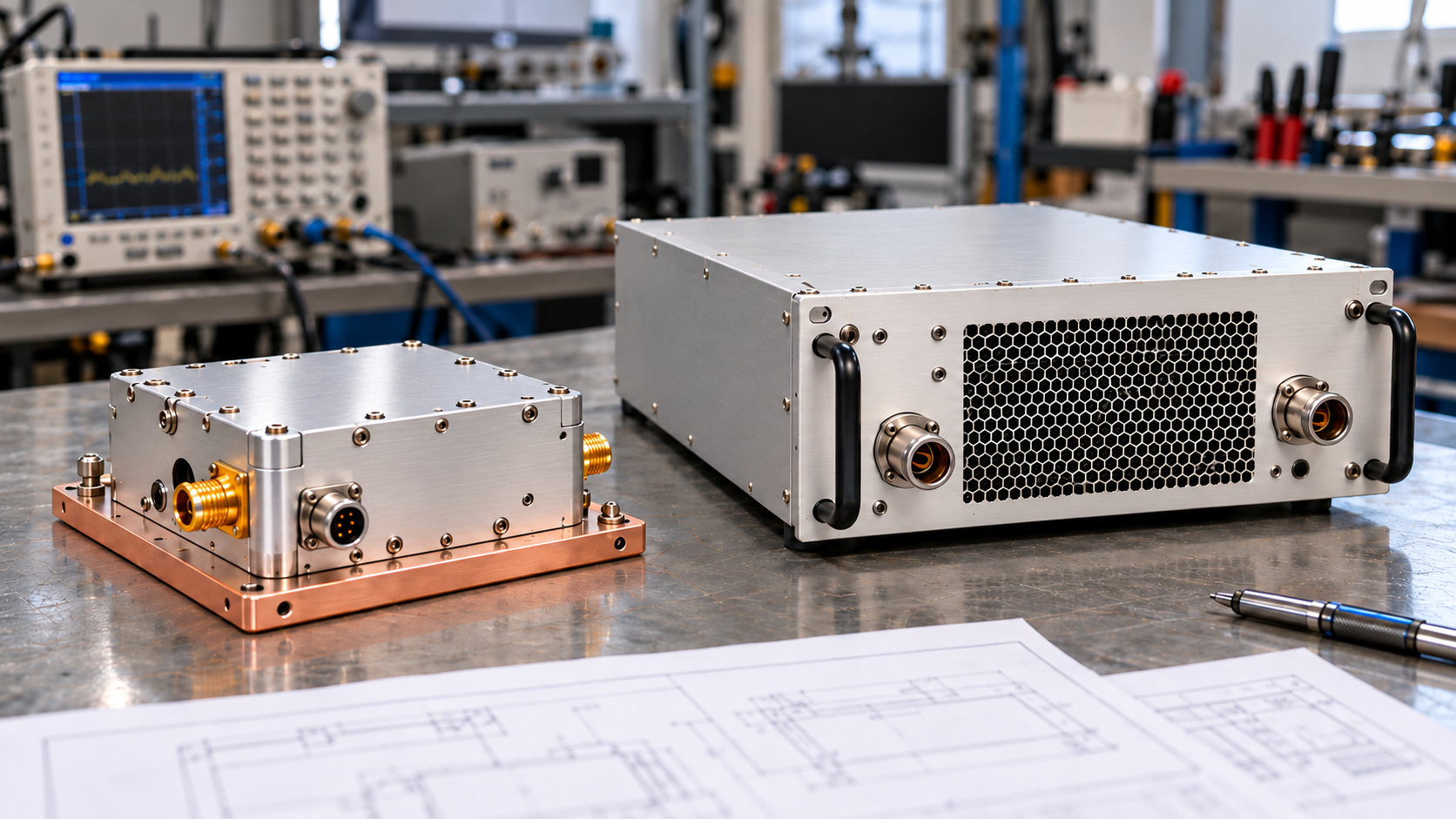
A solid state power amplifier (SSPA) uses semiconductor devices to amplify RF signals. An RF power amplifier module is a product format for integration into larger equipment. The same amplifier can be both.
A supplier’s “100 W SSPA” quote could cover a DC-powered module, a partly integrated assembly, or enclosed equipment. The name alone does not tell the buyer who supplies power conversion, cooling, controls, protection, or a chassis.
Before comparing prices, identify what will be shipped, what the buyer must add, and where the quoted RF performance applies.
1. Does a Solid State Power Amplifier Have to Be a Complete Amplifier?
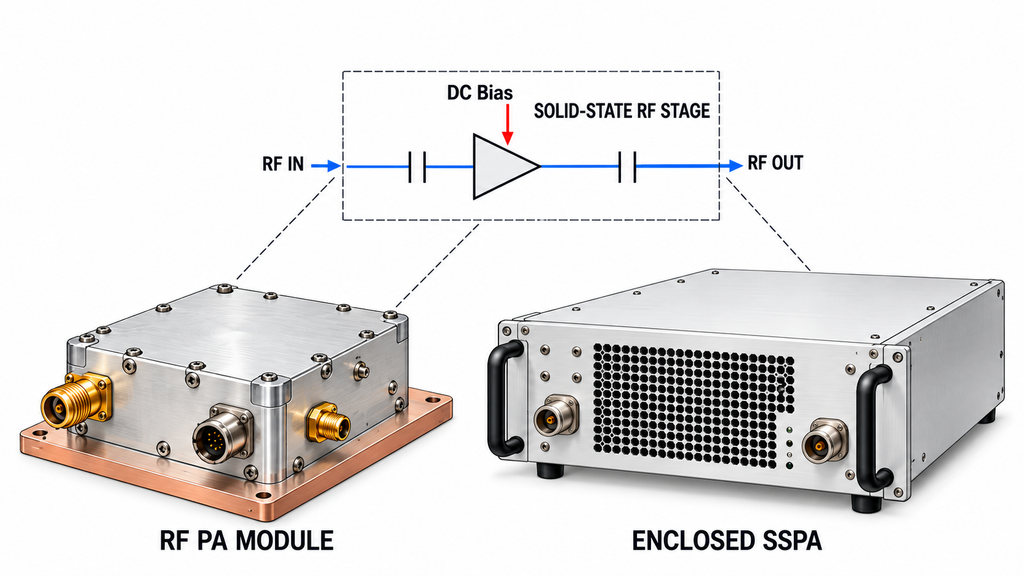
No. SSPA describes the amplification technology, not a fixed package or equipment boundary. GaN, GaAs, and LDMOS are examples of semiconductor technologies used in RF amplifiers.
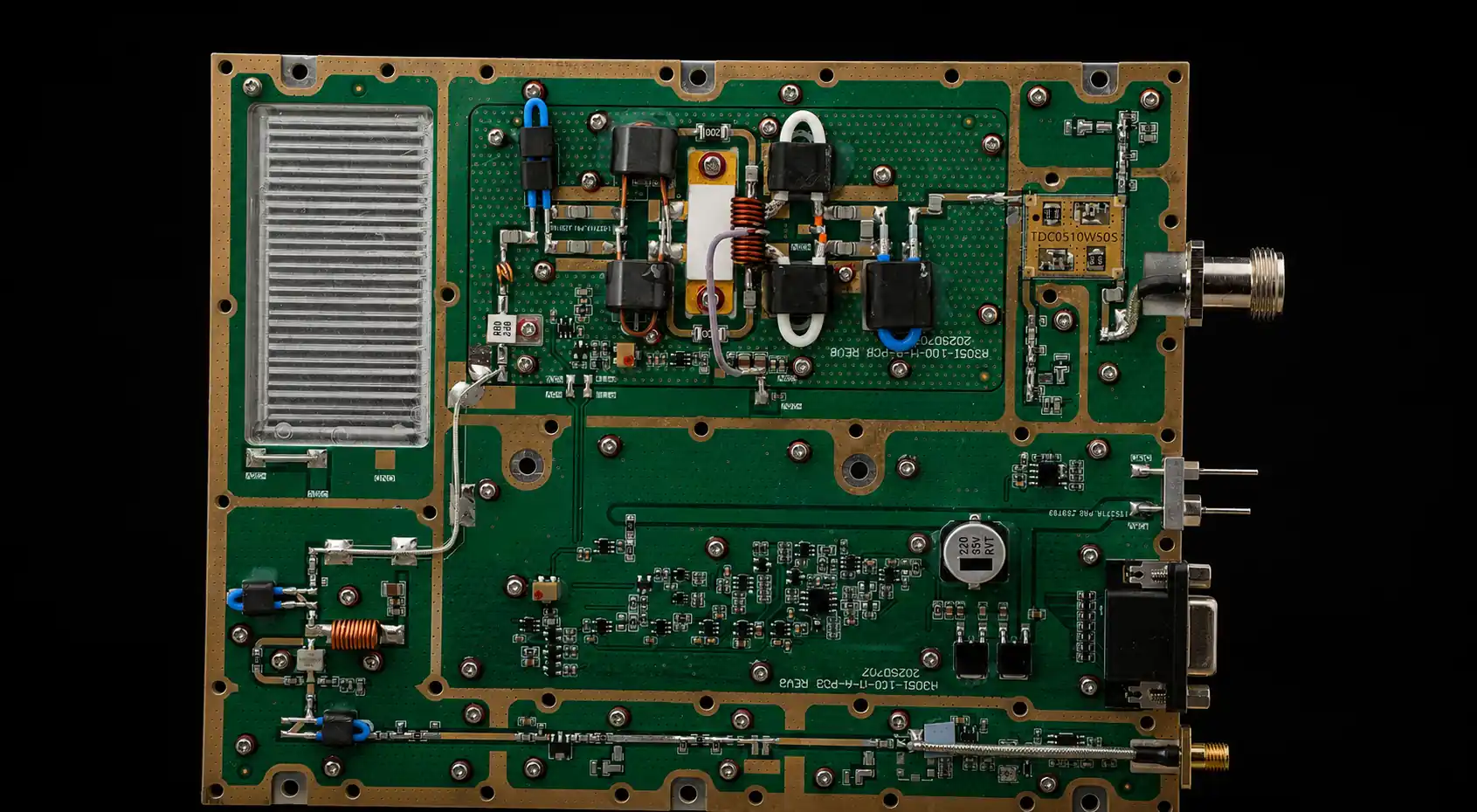
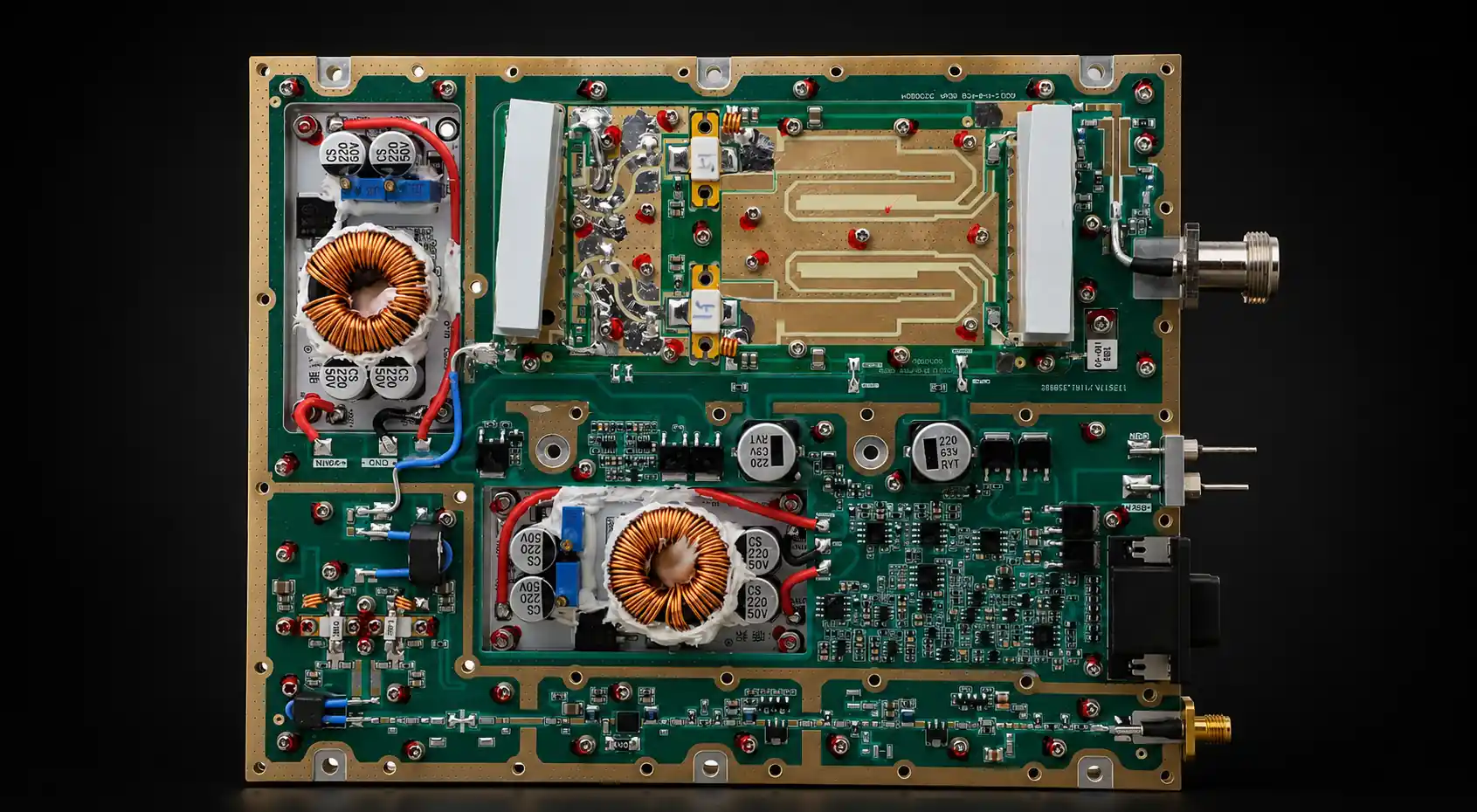
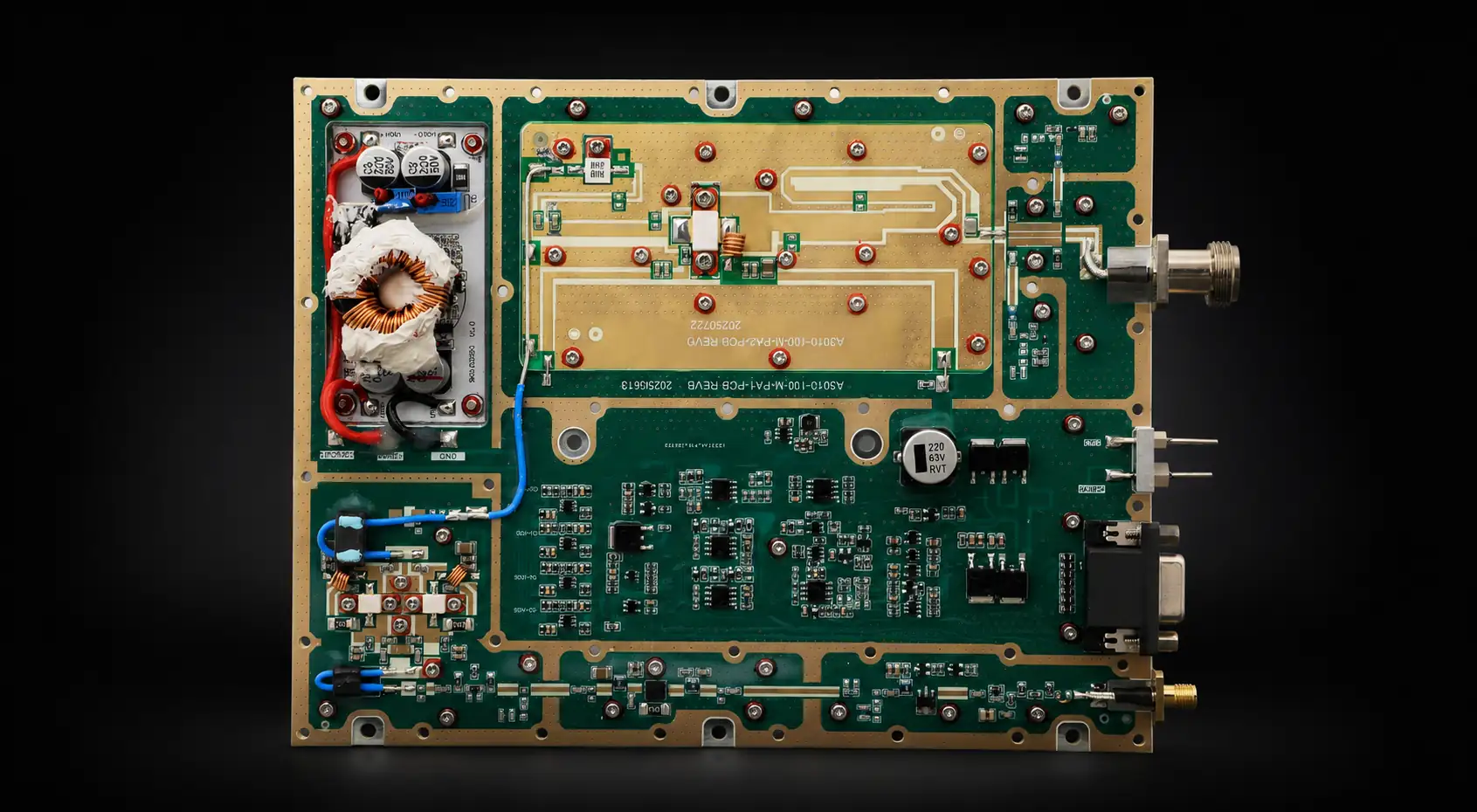
An SSPA supplied as an RF power amplifier module has defined RF, electrical, thermal, and mechanical interfaces for integration. It may contain driver stages, matching networks, bias circuits, monitoring, or protection. The model documents must identify the functions actually supplied.
An enclosed SSPA can use the same amplification technology while adding a chassis and selected support hardware. The buyer must establish the delivered product layer from the configuration and scope documents, not the SSPA label.
2. Why Can the Same SSPA Label Describe Different Products?
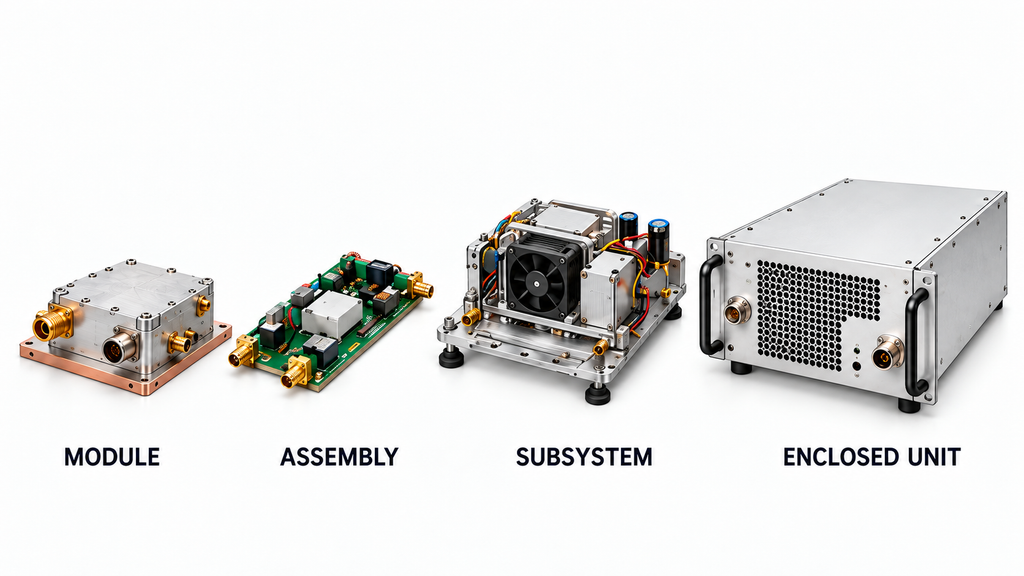
SSPA labels vary between suppliers. In quotations, they can refer to four common delivery formats:
- RF amplifier module: The RF amplification building block, with defined interfaces for external equipment.
- Amplifier assembly: One or more RF stages combined with selected circuits or mechanical hardware.
- Integrated RF subsystem: An assembly with specified support functions, such as power conversion, filtering, cooling, or controls.
- Enclosed amplifier: A chassis-based unit with defined external connections and any support functions listed in its configuration.
These are working descriptions, not formal industry grades.
A product photo cannot confirm what the supplier includes. A metal baseplate may still need an external heatsink. An enclosed unit may accept external DC rather than AC mains. A fitted fan does not, by itself, establish adequate cooling at the required thermal load.
“VSWR protection” could mean fault reporting, automatic power reduction, or shutdown. Ask for the fault-response specification, operating limits, and any external interlocks the buyer must provide.
Ask for the part number, configuration revision, functional block diagram, and priced option list. A controller or cooling kit omitted from the quote can change the true purchase cost.
3. What Must Be Included in an SSPA Supplier Quotation?
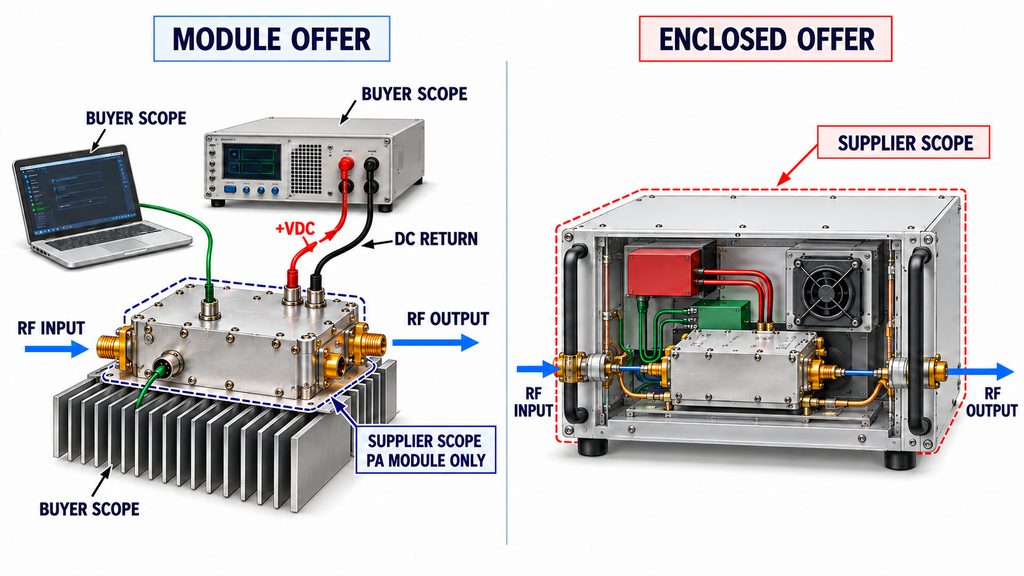
Every quote should make two things clear: what arrives with the product and what the buyer must add. A module-only offer can be complete for a project that already has suitable DC power, cooling, mounting, and controls.
Record the proposed supply scope in the matrix below. For each item, the supplier should select I (included), E (excluded), O (optional), or TBD (not yet confirmed), then state the exact configuration. The buyer-responsibility column applies when the relevant function is not included.
| Quotation Item | Included in Supplier Scope? | Buyer / Integrator Responsibility | Required Supporting Document | Open Question Before RFQ |
|---|---|---|---|---|
| RF amplification stages and driver | Select I / E / O / TBD | Supply any external driver stage or required RF drive chain | RF block diagram and drive specification | Must the supplier include both driver and final RF stages? |
| Power supply and conversion | Select I / E / O / TBD | Supply external DC power, conversion, distribution, and protection as needed | Electrical interface specification | What input is required at the delivered power terminals? |
| Cooling and thermal hardware | Select I / E / O / TBD | Provide any external heatsink, airflow, or liquid-cooling path | Thermal interface requirements and mounting drawing | Which cooling hardware supports the quoted operating condition? |
| Mechanical enclosure and mounting | Select I / E / O / TBD | Supply any excluded chassis, structure, covers, or environmental protection | Mechanical drawing and included-parts list | What physical assembly and mounting hardware will ship? |
| Control and status interfaces | Select I / E / O / TBD | Integrate external controller, wiring, or software where required | Interface control document | Which commands, status signals, and controls are present? |
| Protection and interlocks | Select I / E / O / TBD | Implement required external interlocks and system safeguards | Fault-response and protection description | What does the delivered unit do during a specified fault? |
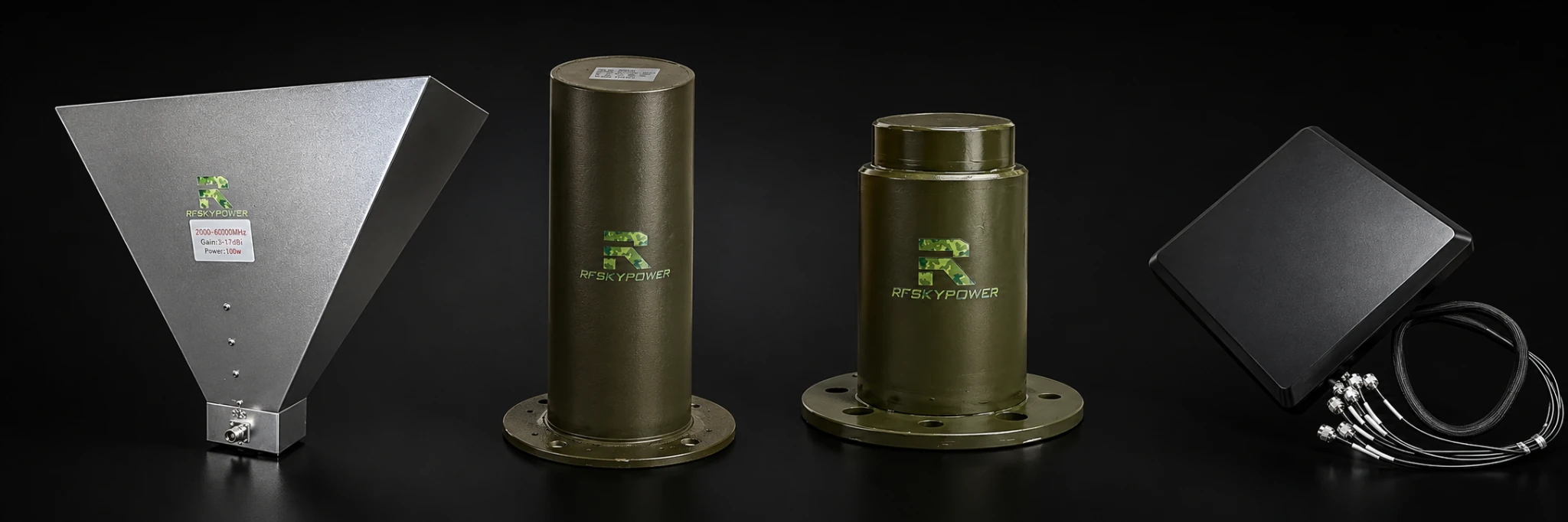
| RF connectors and internal signal path | Select I / E / O / TBD | Supply and verify excluded filters, switches, couplers, and cables | RF block diagram and port definition | At which RF connector is output power specified? |
| Factory testing | Select I / E / O / TBD | Plan integration or equipment-level tests outside the supplier’s scope | Agreed test procedure and applicable test report | Which configuration, ports, and conditions will be tested? |
| Shipment and acceptance documents | Select I / E / O / TBD | Define and obtain any additional contractual records | Deliverables list and agreed acceptance requirements | Which drawings, instructions, records, and certificates will be delivered? |
Once completed, each status records the supplier’s response. The template does not assume that any function is included. A quote is still incomplete when a decision-critical item remains TBD.
Consider two hypothetical 100 W offers. Supplier A quotes a DC-powered module; the buyer supplies its heatsink and control system. Supplier B quotes an enclosed amplifier with a specified power supply, cooling hardware, and equipment controls. Both may be valid 100 W SSPA offers, but their prices cover different work.
Compare the complete purchasing cost, including external power, cooling, mounting, control integration, and any additional tests. Put the agreed inclusions, exclusions, and responsibilities into the accepted quotation or purchase agreement before ordering.
4. Where Do RF Power and Test Specifications Apply?
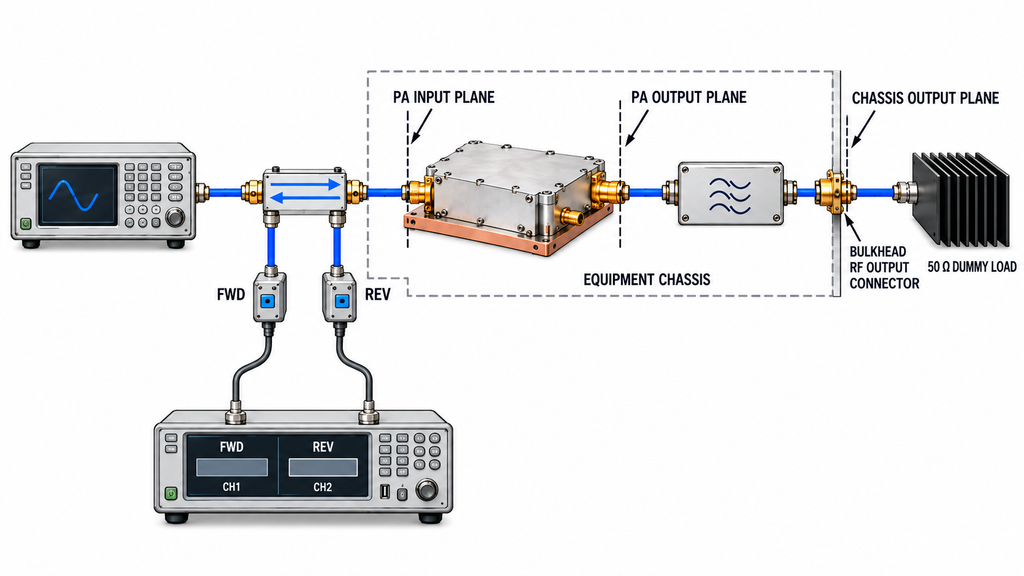
The delivered hardware boundary and the RF measurement boundary may differ. A module rating may apply at its output connector, while an enclosed amplifier rating may apply at an external chassis port.
RF output reference plane
A hypothetical module could deliver 100 W at its output connector under stated conditions. If the installed signal then passes through filters, switches, or cables, their insertion loss can lower the power at the chassis output. The module-port value does not establish the chassis-port value.
State the required output connector and power definition in the RFQ. Ask for evidence at that reference plane if the final equipment output is part of the supplier’s obligation.
Actual RF input power
A signal generator’s setting is not necessarily the input power at the PA connector. Cables and other passive parts between those planes introduce loss.
For a directional-coupler sample, document the coupling factor and sample-path loss. Also account for loss between the coupler’s main-line output and the PA input reference plane.
The test record must also say whether Pin means incident or accepted input power. A forward-power sample alone cannot show how much power the PA accepts when some is reflected.
Electrical input and test scope
A module’s DC consumption at its terminals is not the same quantity as an enclosed unit’s AC consumption at the mains input. The latter can include power conversion and support loads.
Frequency, waveform, duty cycle, load, thermal state, and RF power definition also affect the meaning of a test result. A module bench report supports the tested configuration and conditions; it does not prove acceptance of the integrated equipment.
Request the tested revision, input and output reference planes, operating conditions, and the level of testing covered by the quotation.
5. What Documents Should Buyers Request Before Comparing SSPA Offers?
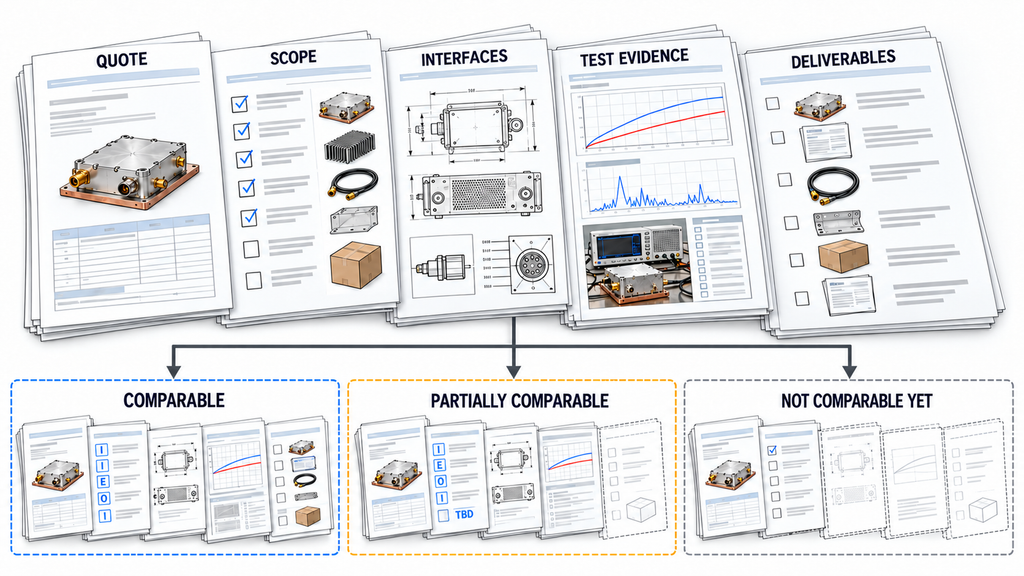
Start with a configuration-specific quotation showing the exact part number, revision, selected options, and price for each option. Add a scope-of-supply list that states what the supplier includes, excludes, or expects the buyer to provide.
The functional block diagram and interface documents should identify the external DC, RF, cooling, control, and mechanical connections. Request the applicable test procedure, test report or proposed evidence package, and a shipment document list. A generic family datasheet does not confirm that a quoted option is included.
Use the following statuses for supply-scope comparison. They do not rank RF performance.
| Comparison Status | When It Applies | Buyer Action |
|---|---|---|
| Comparable | Each quote defines the shipped configuration, included functions, exclusions, buyer dependencies, RF test boundary, and deliverables. Any scope differences can be costed. | Compare price plus the remaining integration, support hardware, and testing costs. Evaluate RF performance separately. |
| Partially Comparable | The main product format is known, but a material option, interface, or responsibility remains unclear. | Request a written clarification or revised quote for the affected item. |
| Not Comparable Yet | The physical deliverable is unclear, or critical supply and acceptance responsibilities are missing. | Hold the scope-based price comparison until the missing items are documented. |
“Not Comparable Yet” means the buyer lacks enough scope evidence to compare the offers. It does not mean the RF hardware has failed.
After confirming the supplied hardware and exclusions, buyers can compare RF power amplifier quotations against the same application requirements, test conditions, and evidence level.
6. Should You Request an RF PA Module or a Complete SSPA System?
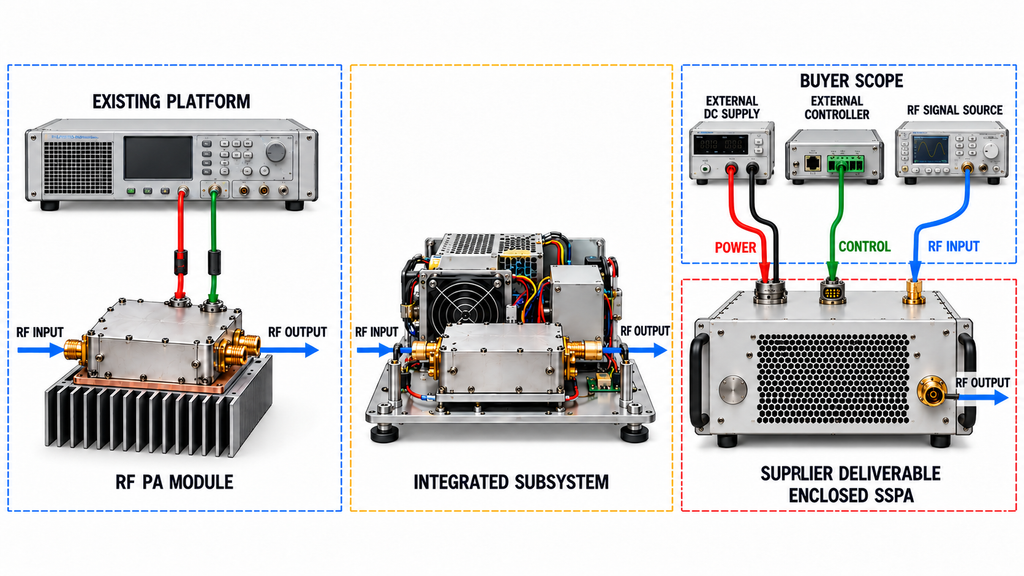
Choose the product format according to the integration work your team can perform and verify.
Request an RF PA module if your team already owns the supporting system.
This fits an established platform with suitable DC power, cooling, mechanical support, control logic, and external protection where required. The quote then needs to define the module’s RF ports, power inputs, thermal interface, mounting, and control connections.
Frequency and output class can narrow the RF power amplifier module options, but model-specific documents must still confirm DC, cooling, mounting, control, and operating limits.
Request an amplifier subsystem if you want selected support functions supplied together.
Specify which power-conversion, cooling, filtering, monitoring, and protection functions must be included. For example, a subsystem with status outputs may still need an external controller and software. Those remain buyer tasks unless the scope includes them.
Request a complete SSPA system if you need an enclosed equipment-level deliverable.
Define the required power inlet, cooling arrangement, external controls, RF connectors, and equipment-level output and test planes. Even an enclosed unit does not automatically include the antenna, downstream distribution, supervisory equipment, or site infrastructure.
What Should the RFQ Specify?
A short scope statement can prevent suppliers from quoting different product layers:
Please quote a [RF PA module / amplifier assembly / integrated subsystem / enclosed SSPA]. The supplier shall provide [RF stages and supporting functions]. Our team will provide [external equipment and integration work]. Quoted RF output shall apply at [connector or reference plane] under [specified frequency, waveform, duty, load, power, and thermal conditions]. The quotation shall define [factory test scope and acceptance criteria], [module-level or equipment-level test boundary], and [drawings, configuration records, and reports required at delivery].
Attach the full technical specification. Use the Section 3 matrix to resolve exclusions and options, then put the agreed supply scope, test procedure, and acceptance criteria into the purchasing documents.
Conclusion
A solid state power amplifier may be delivered as an RF PA module, an amplifier assembly, or enclosed equipment. SSPA describes the amplification technology; it does not guarantee a power supply, cooling system, controller, or chassis.
The quotation and interface records can establish the proposed supply boundary. They cannot, by themselves, prove model suitability or final equipment acceptance. Those decisions need evidence for the specified RF output, operating conditions, test planes, and acceptance criteria.
Before comparing prices, have each supplier confirm the included and excluded items. Incorporate the agreed deliverables, buyer responsibilities, and acceptance scope into the quotation or purchase agreement.
For a module-level project, share that scope and your interface requirements with the RF SKYPOWER engineering team for a configuration review.