
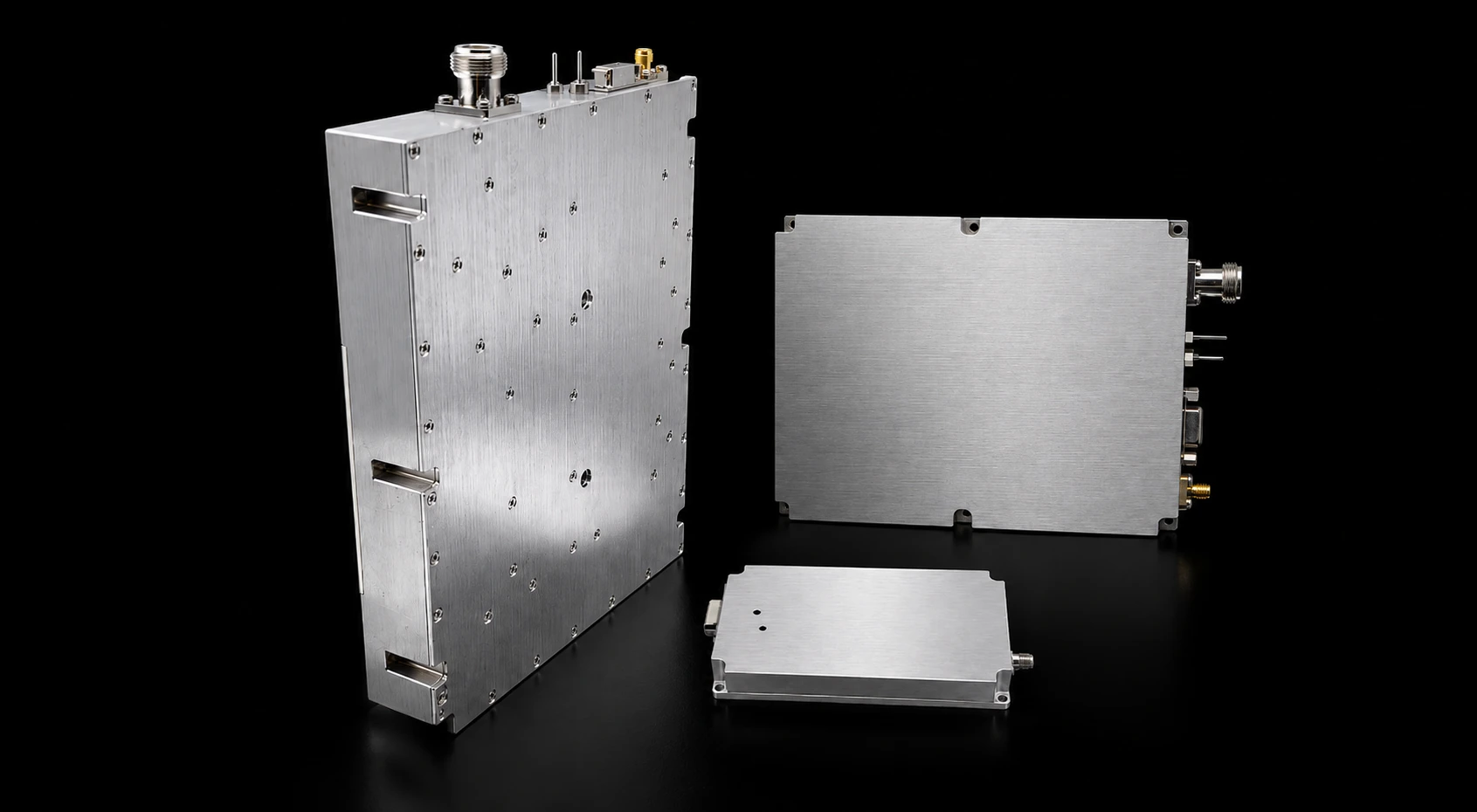
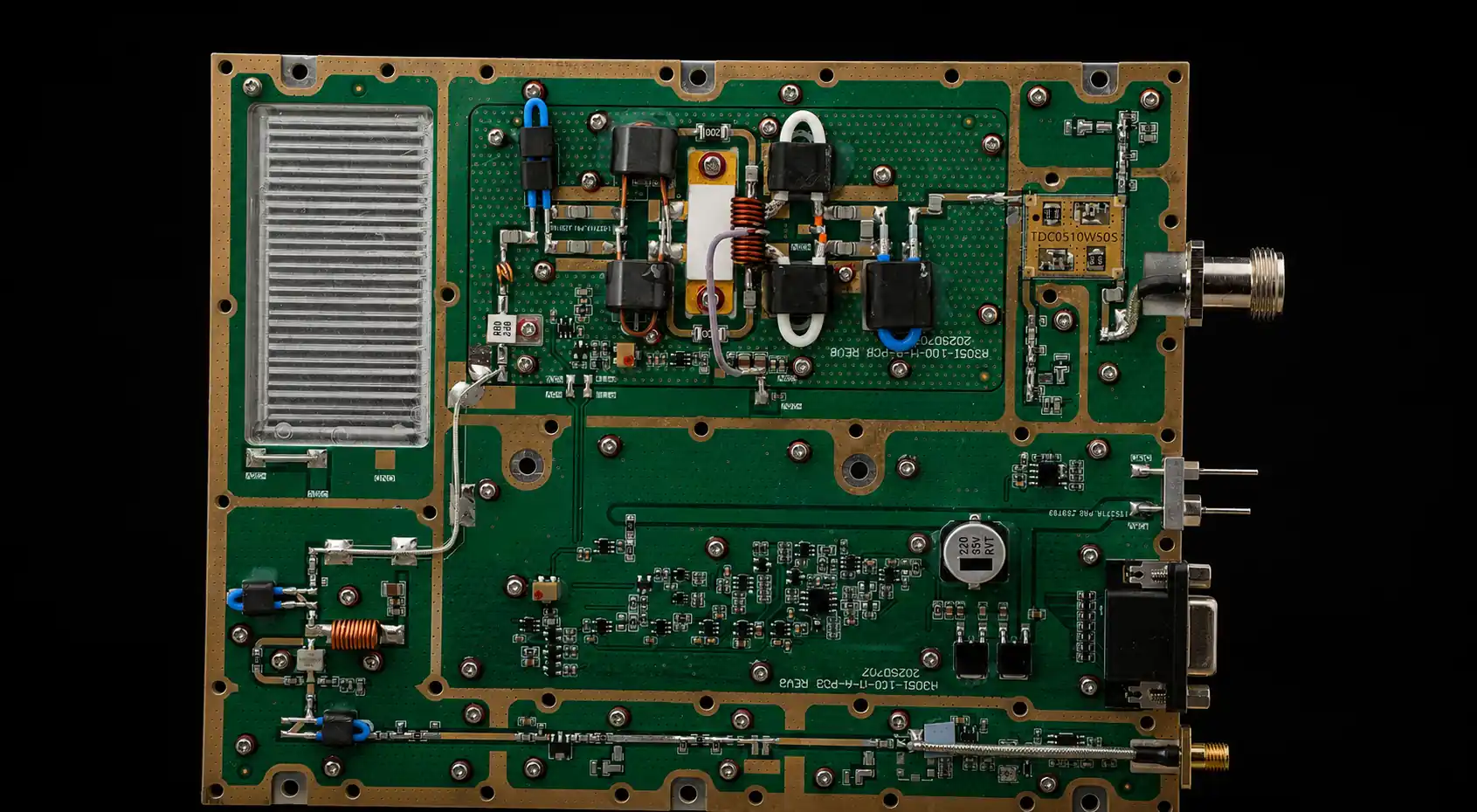
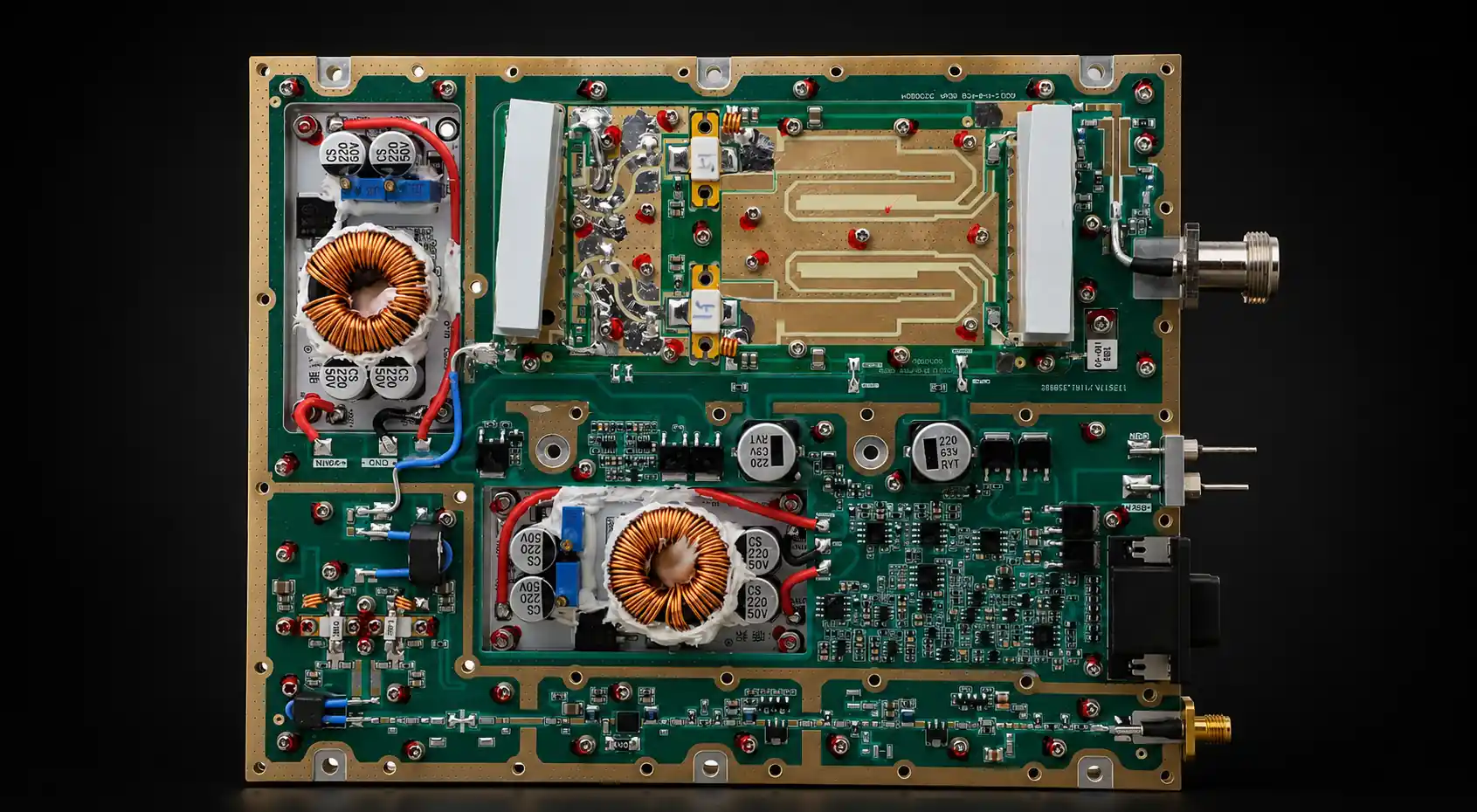
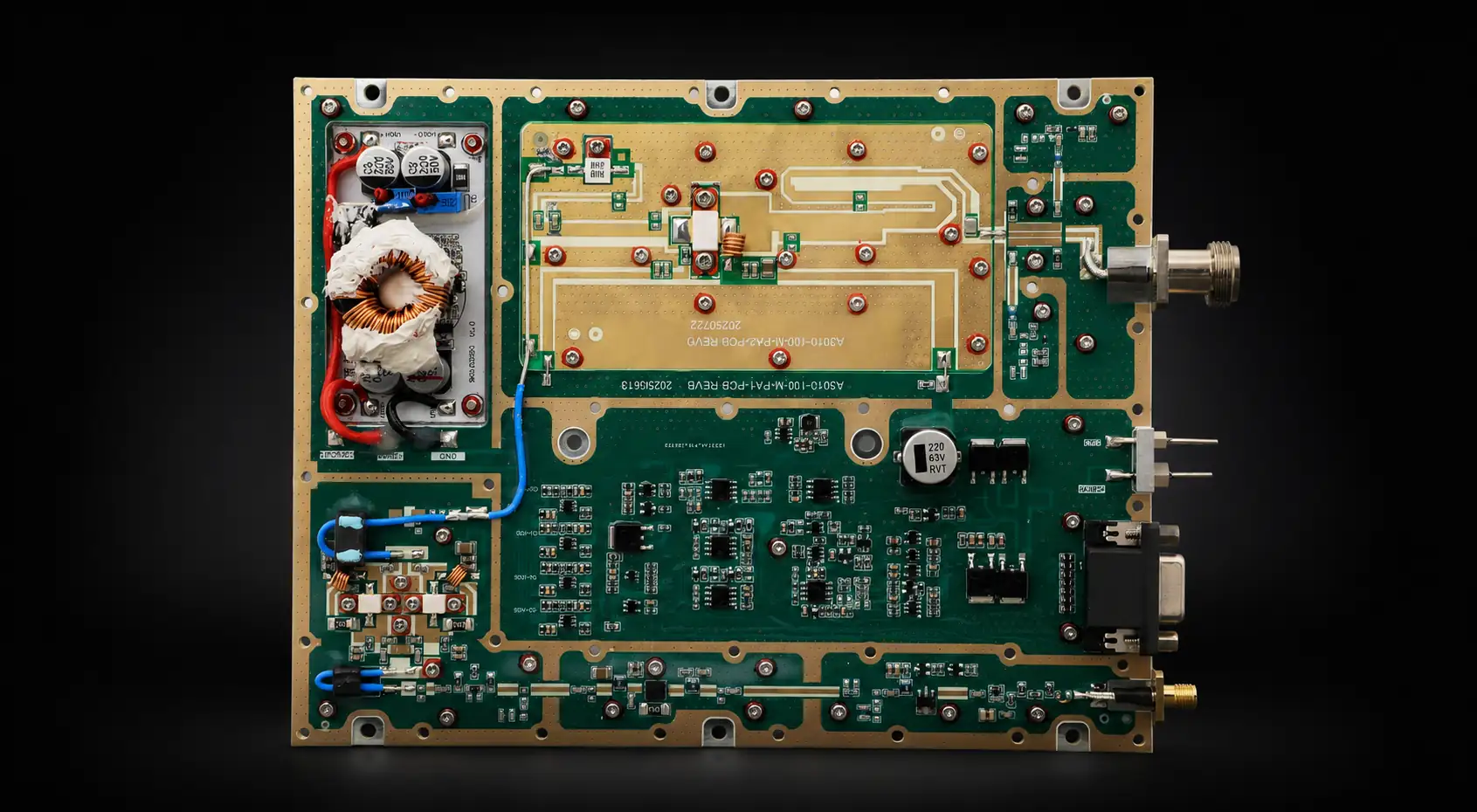



RF power amplifier lead time depends on the engineering, purchasing, production, verification, and approval steps that control the agreed delivery date. Before accepting a quoted number of weeks, define the amplifier configuration, order quantity, start event, and delivery endpoint.
A supplier may be ready to assemble a module while the buyer still reviews the design. Hardware may also be complete while required test reports await sign-off. A schedule that omits either wait can make a conditional estimate look like a delivery commitment. Start by agreeing where the lead-time clock starts and stops.
1. What Starts and Ends the RF Power Amplifier Lead-Time Clock?
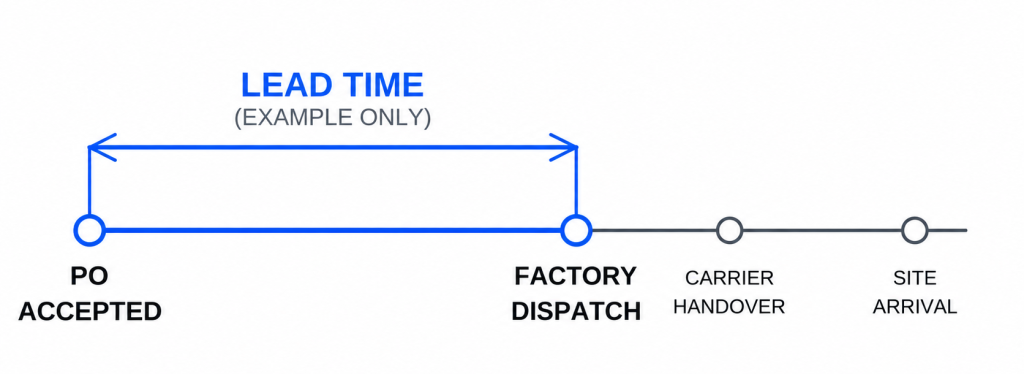
The start date may be the supplier’s acceptance of a purchase order, receipt of an agreed deposit or commercial release, approval of a technical specification, design freeze, or authorization to purchase critical materials. These events can occur on different dates. The quote or order acknowledgement should name the event that starts the clock and identify any later approvals on which the estimate depends.
Define the endpoint separately. Factory dispatch means the goods have left the manufacturing facility; carrier handover, arrival at the destination, and customer acceptance are separate milestones. The allocation of transport responsibility follows the agreed commercial terms. Include transit, customs, receiving inspection, and acceptance work when they fall within the agreed delivery scope. A manufacturing cycle measured from material release to completed assembly is not necessarily the order-to-delivery lead time.
Supply route also changes what the clock covers. A standard module available from confirmed inventory may proceed directly toward order-specific checks and dispatch. A modification of an existing platform may require revised drawings, components, or verification. A new custom RF power amplifier design may require an approved design baseline and prototype decisions before production release. These are conditional paths, not fixed duration categories.
For scheduling, record one unambiguous statement covering the configuration revision, quantity, start trigger, delivery endpoint, and outstanding buyer-dependent conditions. Until both endpoints and the applicable scope match, two quoted lead times are not directly comparable and should not be approved as a common project baseline.
2. Which Requirements Must Be Frozen Before Scheduling Can Be Trusted?
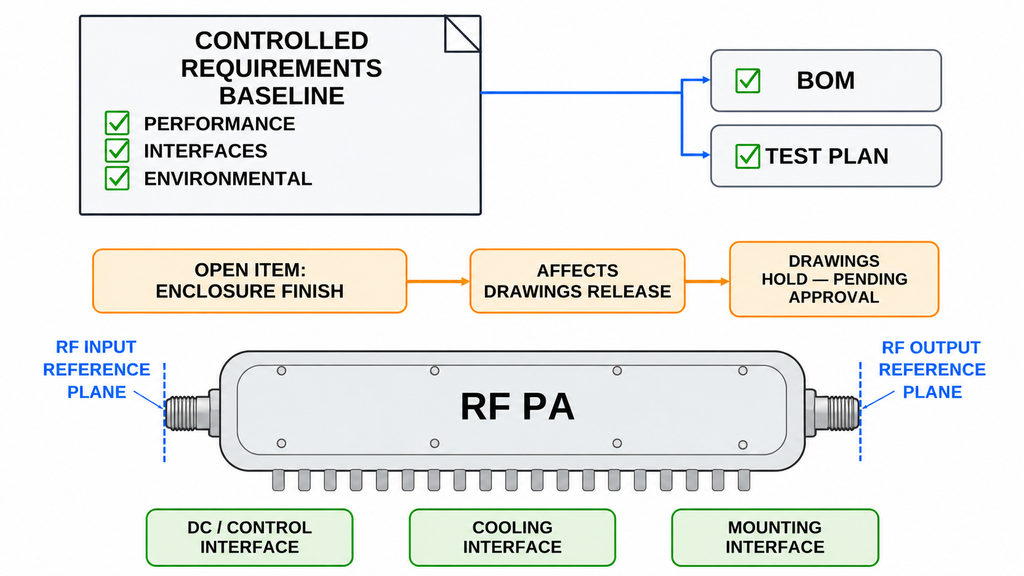
A credible build schedule starts with a controlled technical baseline: the version of the requirements against which the supplier can purchase parts, release drawings, and plan verification. “Specifications agreed” is too vague if an unresolved item can still alter the hardware or the acceptance scope.
For an RF PA module, the baseline should identify the operating band and priority frequencies; available drive power at the defined PA input reference plane; required output at the defined PA output reference plane; waveform and duty cycle; DC supply conditions; cooling and thermal interface; mounting and connector constraints; control interface; and order quantity or batch structure. The project must also define the tests, any burn-in requirement, report format, and approval evidence needed before shipment. A signal-generator setting should not silently stand in for actual power at the PA input.
The buyer’s engineering team and supplier should sign off the applicable requirement and drawing revisions, with a date and an owner for each unresolved item. Some work can proceed conditionally: for example, purchasing an approved common component while an unrelated mechanical detail is still open. That decision needs written authorization and a record of who accepts any rework or material exposure if the design changes.
If frequency coverage, output conditions, thermal or mechanical interfaces, or the test scope could still force a redesign, treat the design-completion date as provisional. The buyer should leave this stage with a signed requirement baseline and an open-item record naming each decision that blocks the next release.
3. How Do Long-Lead Parts, PCBs, and Machining Affect the Earliest Build Date?
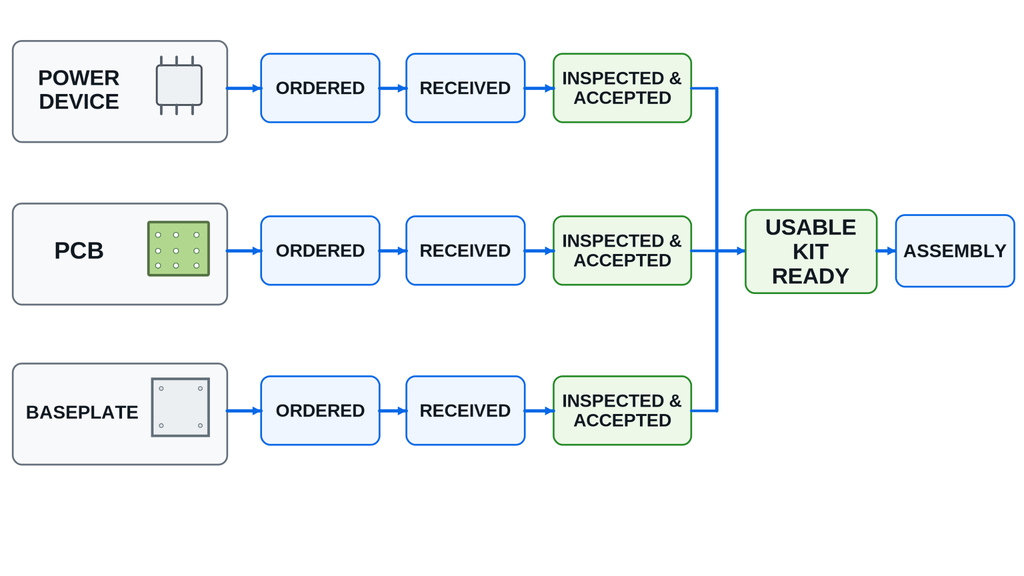
A long component quote matters when that component lies on the route to assembly or later verification. It does not automatically determine final delivery. Procurement needs the date when the approved, usable build set will be available.
Power devices, matching and filtering components, connectors, PCB fabrication, heatsinks, and machined baseplates may follow different purchasing and release paths. For each critical item, procurement needs the approved part or drawing revision, source, purchasing authorization, supplier-confirmed availability, and expected date when the part will be received and cleared for use. “Ordered,” “received,” and “ready for assembly” describe different states.
PCB production and mechanical machining may run alongside procurement of already approved parts. That overlap is meaningful only if released files and interfaces are compatible with the intended production revision. Buying material ahead of final approval can shorten a dependency in some projects, but it creates a controlled at-risk purchase; a substitute device or revised machined part may require engineering review and renewed verification.
Ask the supplier to identify the earliest date on which the required build set can be kitted, including inspection or acceptance of incoming parts. If a key source, drawing revision, or buying authorization is still unconfirmed, the planned assembly start remains conditional. A material status record should distinguish the genuine build constraint from items that have scheduling float.
4. Which Design Reviews and Prototype Approvals Release Production?
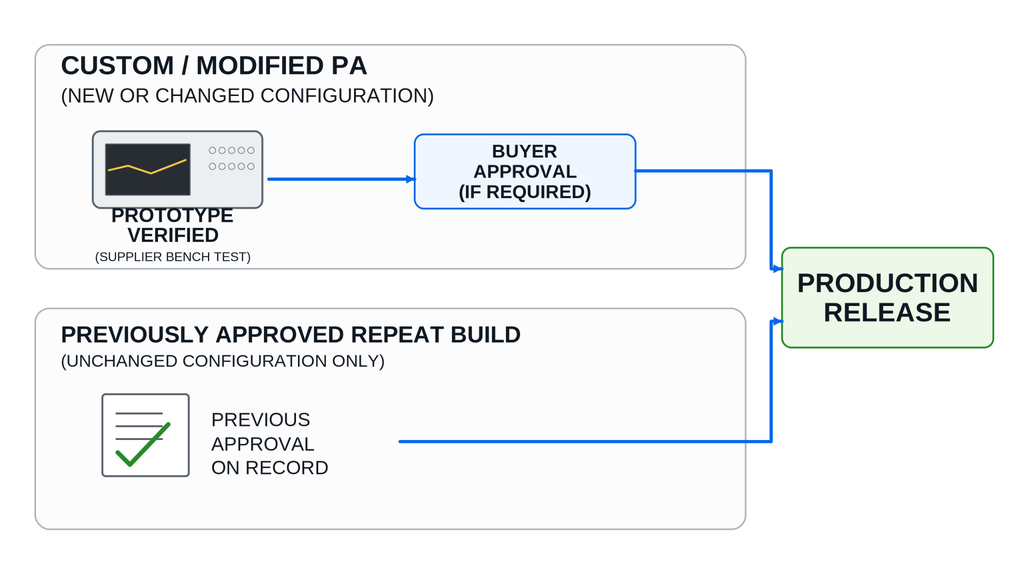
An internal design review, completion of prototype testing, customer acceptance of a prototype, and authorization for production are distinct events. A schedule should show the ones required by the actual order rather than assuming every RF PA follows the same approval sequence.
A repeat order for an unchanged, previously approved module may have no new prototype gate. A modified or custom configuration may need the buyer to evaluate the applicable RF behavior, DC and control interfaces, mounting fit, cooling arrangement, and operating conditions. Prototype evidence must identify the tested hardware and control revision and the conditions under which the results were obtained. Open issues should be closed or explicitly dispositioned before the project treats the corresponding approval as complete.
The supplier can finish its own design or prototype work and still be waiting for the OEM’s sign-off. Record prototype verification complete and buyer prototype approval separately. For buyer approval, name the approver, submission date, agreed decision deadline, and actual decision date; identify an escalation owner if the review slips. If production requires a further release, that authorization should point to the approved configuration and any conditions attached to it.
Where a required prototype approval, major issue closure, or production revision is missing, mark the production-release milestone as blocked. A prototype result supports the tested configuration and scope; subsequent production-unit evidence remains governed by the agreed production and acceptance plan.
5. What Testing, Burn-In, and Documentation Can Hold Shipment Release?
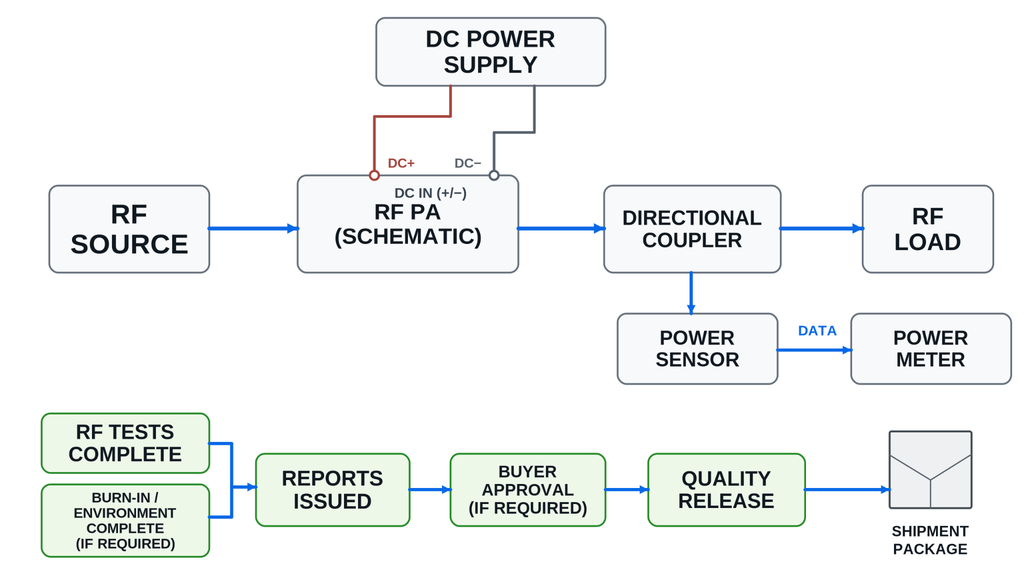
Completed assembly establishes manufacturing progress, while shipment release depends on the verification and documentation gates agreed for the order. An RF test may be finished before its data are reviewed; a report may be drafted before it is approved; quality authorization may follow both.
Reserve test resources in the schedule and define the RF operating conditions, thermal state, load, and any environmental or burn-in activity specified in the acceptance plan. Burn-in duration and criteria are project-defined. Where burn-in is required, the RF PA burn-in conditions and batch records should be traceable to the items and acceptance scope being released. An anomaly may require investigation, retesting, and another review cycle. Track those open steps separately from completed test-station time.
A prototype report, a batch-sampling record, and a report tied to an individual delivered serial number support different acceptance decisions. If the buyer requires unit-specific records, the RFQ and acceptance plan should name the unit identity, test conditions, result, report submission point, and approval responsibility. If the buyer must approve those reports before dispatch, allow a separate review milestone with a named approver and target date; otherwise the applicable supplier quality release governs this gate. A process video may show work taking place; the agreed test record and signed release establish the documentary gate.
Ask the supplier to track four separate statuses: testing complete, required reports issued, buyer report approval where required, and quality or shipment release. If a required test remains open, an exception has not been dispositioned, or an agreed report or signature is missing, shipment readiness should remain blocked even if the hardware is packed.
6. Which Tasks Can Run in Parallel—and What Controls the Critical Path?
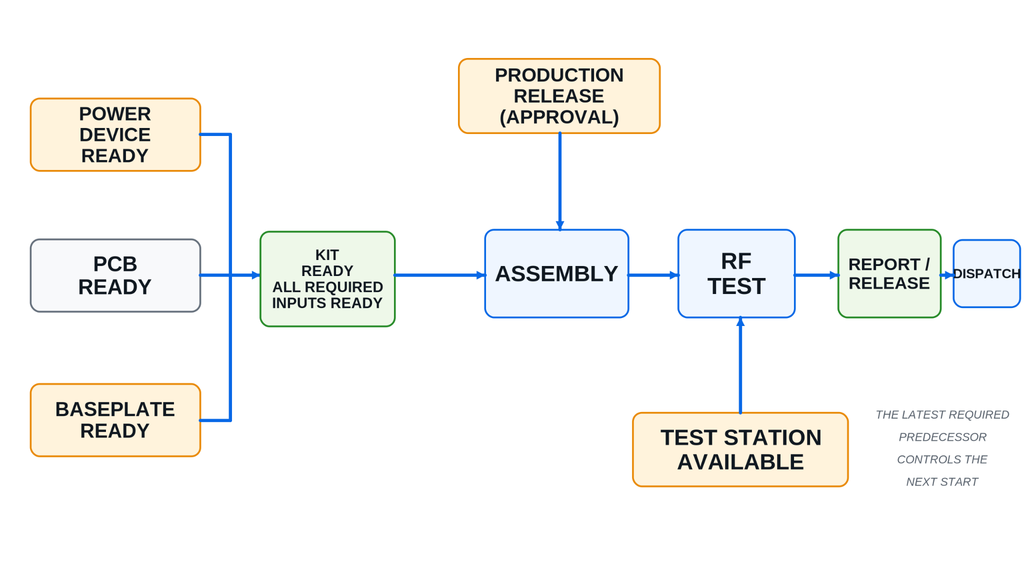
Total RF PA lead time is not the sum of every task duration. The critical path is the sequence of dependent activities that determines the earliest achievable endpoint in the schedule; limited resources and approval availability must also be reflected in the achievable forecast. Work outside the controlling path may have scheduling float; delaying it will affect delivery only after that float is consumed or a dependency changes.
For example, an approved PCB design may enter fabrication while the mechanical team machines a released baseplate and purchasing follows up on an approved power device. Test-fixture preparation and report-template review may proceed during manufacturing. These streams converge when the build needs compatible, usable parts and when completed units enter the agreed test and release sequence. Each proposed overlap must respect any design freeze, procurement authority, and customer approval that precedes it.
To identify the current controlling path, start at the agreed delivery endpoint and trace required predecessors back toward the start event. Where parallel workstreams converge, check which prerequisite becomes ready last, then account for buyer-approval waits and limited manufacturing or test resources. Recheck the path whenever a milestone moves.
A fully built module may wait for a suitable test station, while a short buyer approval may hold up a production release needed by several downstream tasks. Conversely, expediting a part with substantial float may leave the delivery date unchanged.
Ask the supplier for a dependency-linked schedule that identifies the activity or approval currently controlling the agreed delivery endpoint, its owner, and the next decision needed to clear it. Compare alternative schedules only when they use the same configuration, clock boundaries, resource assumptions, and approval conditions. Without those inputs, an accelerated date remains a scenario rather than a confirmed commitment.
7. How Should Design Changes and Buyer Approval Delays Reset the Schedule?
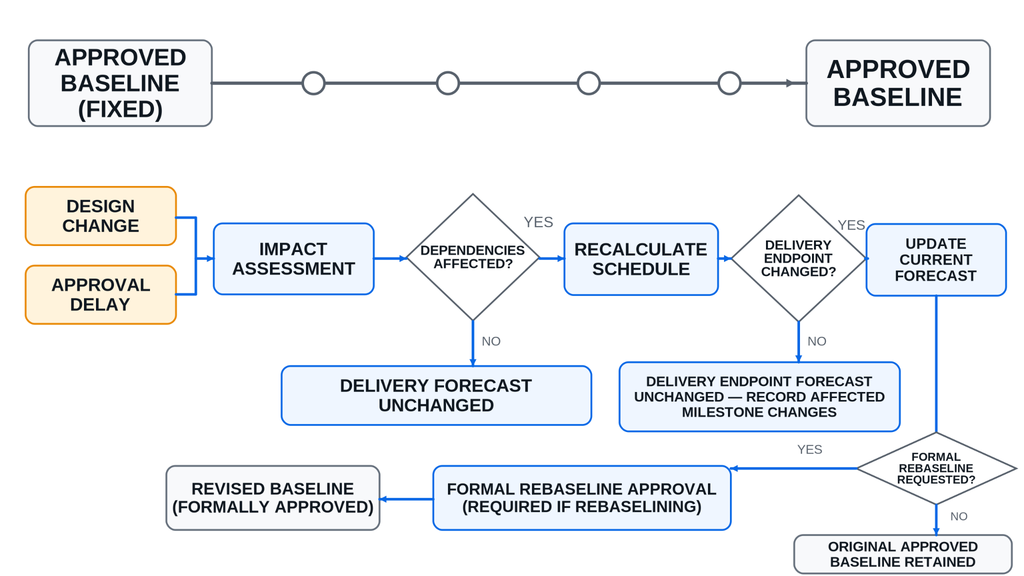
A delivery date belongs to a particular scope and approved revision. When an activity or approval slips, recalculate the dependency-linked schedule. Revise the delivery forecast if the delay changes the projected completion of the agreed endpoint. The approved baseline remains the reference for tracking variance unless the parties formally authorize a revised baseline through the agreed change-control process.
A change to the operating band, power-device choice, PCB, mounting interface, cooling, control behavior, or required testing can reopen procurement, fabrication, prototype verification, or report approval. For C-UAS projects, a revised band may trigger another custom RF PA frequency-range review and, depending on the result, changes to the design and verification scope. Assess materials already purchased and work already completed against the new revision before proposing new dates.
Track buyer approval waits alongside supplier work. Record each change or approval request, its decision owner, submission date, approval date, downstream tasks held, and resulting schedule impact. This establishes a factual timeline without presuming which party bears contractual responsibility for a delay.
The change record should preserve the original baseline date, current forecast, affected scope and milestones, approved disposition, and any formally approved revised baseline. When verification scope, material disposition, or authorization is still open, the forecast remains provisional; a later target date alone does not establish an approved rebaseline or resolve responsibility for the delay.
8. What Should Buyers Require in an RF PA Delivery Milestone Plan?
Ask for one version-controlled milestone plan shared by the supplier, buyer engineering team, procurement, and project manager. It should show what must happen before each step can close, who can approve it, and what evidence makes that approval auditable. The milestone definitions should match the agreed start and delivery endpoint.
The table is a planning template; its blank dates and blockers do not describe an actual RF SKYPOWER order. Milestones may overlap where approvals allow, and each order needs its actual predecessors recorded. Mark a stage Not applicable when the approved scope does not require it; keep the remaining dependencies and approval requirements.
For a live order, use Target date for the currently approved baseline milestone date. In Change handling / schedule update, replace the example actions with the current forecast, variance, action owner, and approval status. Keep the original and any approved revised baseline in the version history. If factory dispatch or carrier handover is the agreed endpoint, the final row confirms that event rather than adding another delivery stage.
| Milestone | Prerequisite | Responsible party | Completion evidence / approval action | Target date | Current blocker | Change handling / schedule update |
|---|---|---|---|---|---|---|
| Requirements and configuration freeze | Accepted scope and defined lead-time clock | Buyer engineering + supplier engineering | Signed specification, interface revisions, and open-item disposition | — | — | Approve the revised requirement baseline |
| Long-lead material purchase authorized | Approved critical BOM and any advance-purchase permission | Supplier purchasing + buyer where approval is required | Documented purchase release tied to the approved revision | — | — | Reassess purchase authority and material exposure |
| PCB and mechanical files released | Approved electrical and mechanical interfaces | Supplier engineering + buyer where drawing approval is required | Released fabrication files and drawing revisions | — | — | Reissue affected files and reassess work in progress |
| Critical parts, PCBs, and machined items ready for assembly | Applicable purchasing, fabrication, and incoming checks complete | Supplier purchasing + production / quality | Usable-kit and completed-machining status tied to the build revision | — | — | Reconfirm kit-ready date and downstream build impact |
| Prototype verification complete, if required | Prototype built to the agreed revision | Supplier engineering / test team | Test results and issue-disposition record for the specified scope | — | — | Repeat affected verification and update evidence |
| Buyer prototype approval, if required | Prototype evidence submitted for review and exceptions dispositioned | Buyer technical approver | Dated decision against the current revision; agreed review deadline recorded | — | — | Escalate overdue review and revise forecast pending sign-off |
| Production release | Applicable design and prototype gates closed | Supplier production owner + buyer if release approval is required | Approved production configuration and build authorization | — | — | Reauthorize production if the baseline changes |
| Production assembly complete | Released build package and usable materials | Supplier production | Build completion and applicable in-process record | — | — | Replan rework and subsequent verification |
| Production RF tests complete | Built units and approved test method/resources | Supplier test team | Results under the agreed frequency, drive, load, and thermal conditions | — | — | Rebook tests and close affected exceptions |
| Burn-in or environmental stage, if required | Applicable units, procedure, and equipment available | Supplier test / quality team | Required logs, results, and retest disposition | — | — | Reschedule the stage and reassess release impact |
| Required test reports issued | Completed applicable tests and unit/batch identification | Supplier report owner | Issued reports identifying the required evidence scope and test conditions | — | — | Reissue affected reports and update review timing |
| Buyer report approval, if required | Required reports submitted under the agreed acceptance plan | Named buyer report approver | Dated report approval or documented disposition | — | — | Escalate open approval and update shipment forecast |
| Quality and shipment release | Required reports, exceptions, and applicable buyer approvals complete | Supplier quality + any buyer release authority | Documented release decision under the order’s acceptance plan | — | — | Reopen release review when acceptance conditions change |
| Factory dispatch | Shipment release and packing requirements complete | Supplier dispatch / logistics | Dated record of goods leaving the factory | — | — | Confirm revised factory dispatch date |
| Carrier handover, if separate | Factory dispatch and applicable pickup arrangements | Supplier logistics + carrier | Carrier receipt or documented pickup acceptance | — | — | Confirm revised carrier handover date |
| Agreed delivery endpoint | Selected order endpoint and its applicable preceding obligations | Responsible logistics / receiving party | Evidence of the named dispatch, handover, arrival, or acceptance event | — | — | Update endpoint forecast; formally rebaseline only if approved |
For each open milestone, name the next decision owner and current constraint. Recalculate dependent dates when a prerequisite or approval changes, and record any resulting endpoint-forecast change against the approved baseline. The parties can then confirm a delivery commitment against the agreed steps, dates, and release evidence.
Conclusion
A realistic RF power amplifier delivery commitment follows the work and approvals on the actual critical path—from an agreed start event and frozen configuration to the specified shipment or delivery endpoint. The controlling path can include materials, machining, production, buyer sign-off, testing, and document release; it cannot be established by adding every quoted task duration or selecting the longest component lead time.
The milestone matrix identifies dependencies and approval owners, but it cannot verify available stock, manufacturing capacity, test duration, or order-specific acceptance limits. Confirm those facts from current supplier and project records. Before accepting a date, procurement and OEM engineering should agree on scope, clock boundaries, approvals, and evidence, then request a dated schedule with each open decision assigned.
For an RF SKYPOWER engineering and delivery review, provide the operating band and priority frequencies; available drive at the PA input and target output at the PA output reference plane; waveform and duty cycle; DC and cooling conditions; mechanical and control interfaces; and order quantity or batch structure. State the prototype and production approval gates, agreed testing or burn-in and report scope, requested delivery endpoint and date, advance-purchase permissions, and change-control rule.
The RF power amplifier module range lists standard frequency and power families for an initial comparison. Flag any nonstandard band, interface, or verification requirement so RF SKYPOWER can review the proposed configuration and approval dependencies before confirming a project delivery date.