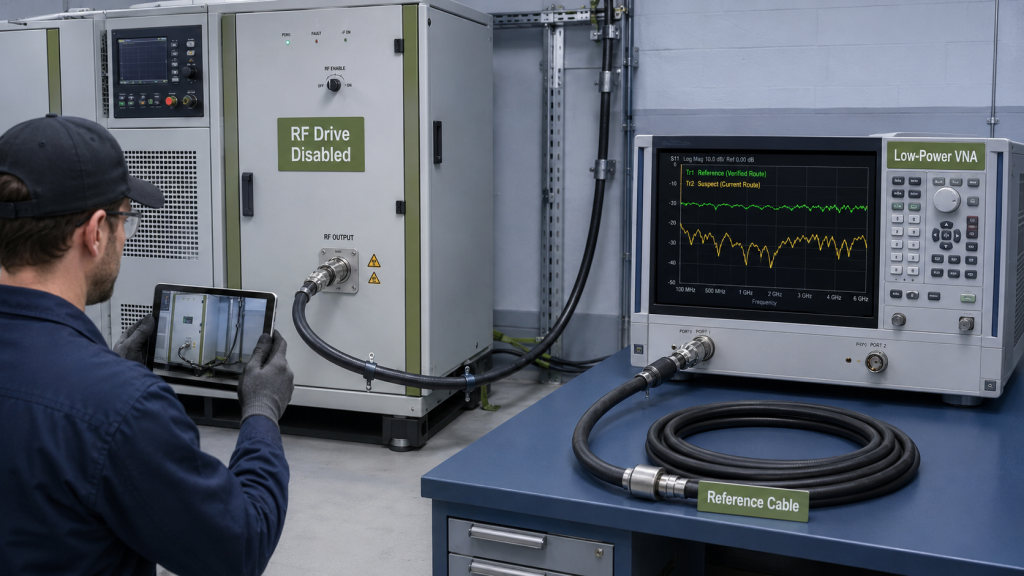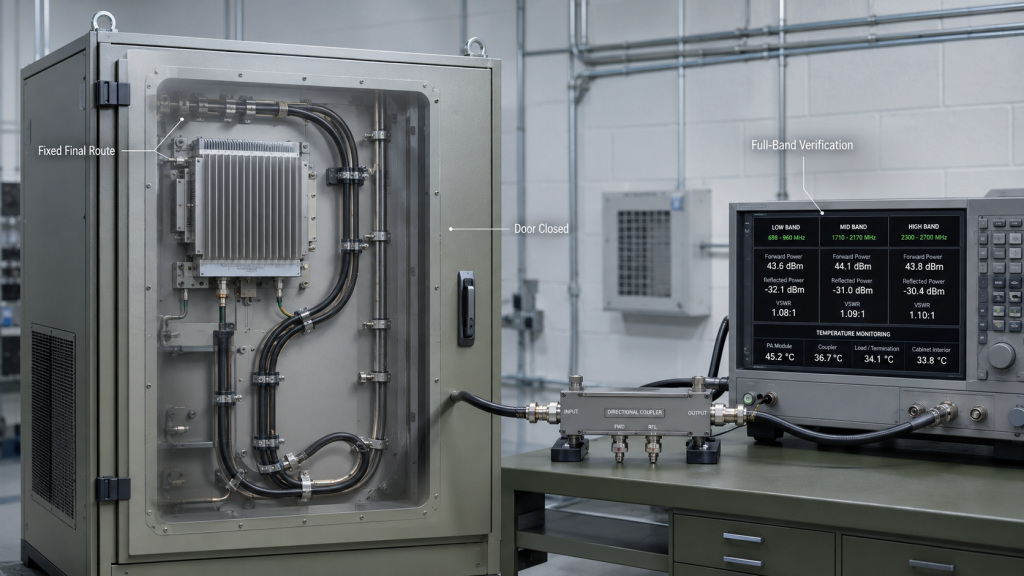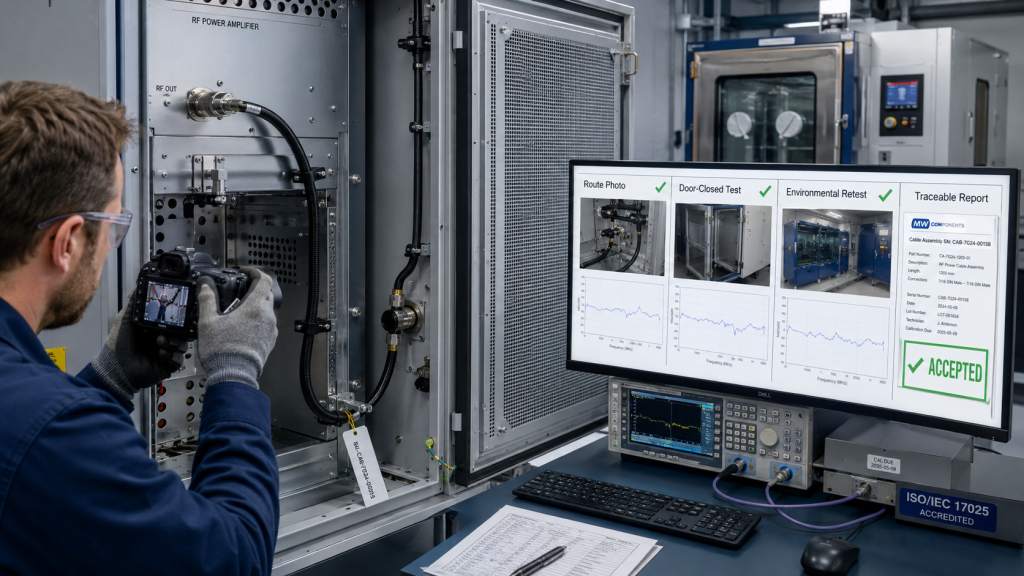
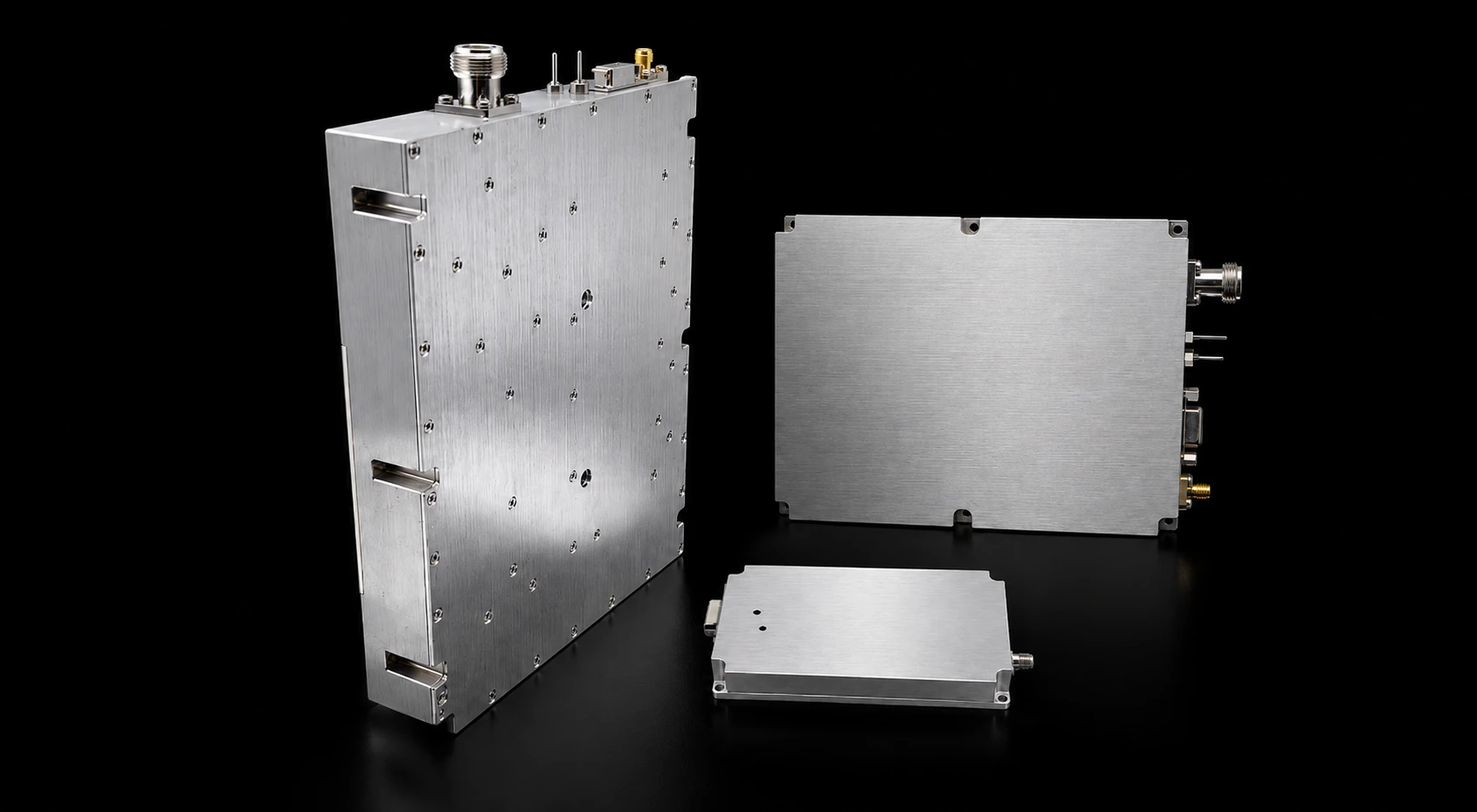
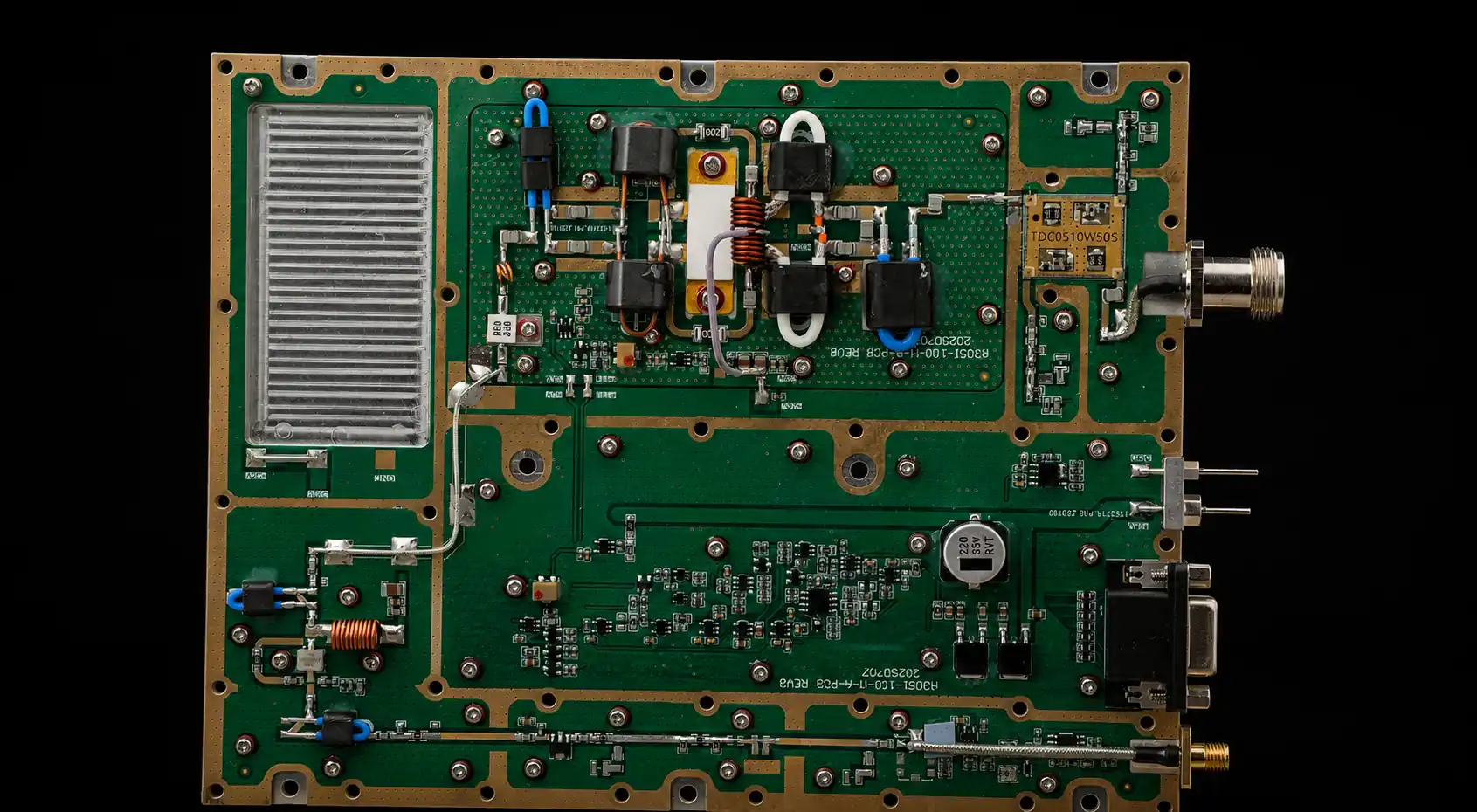
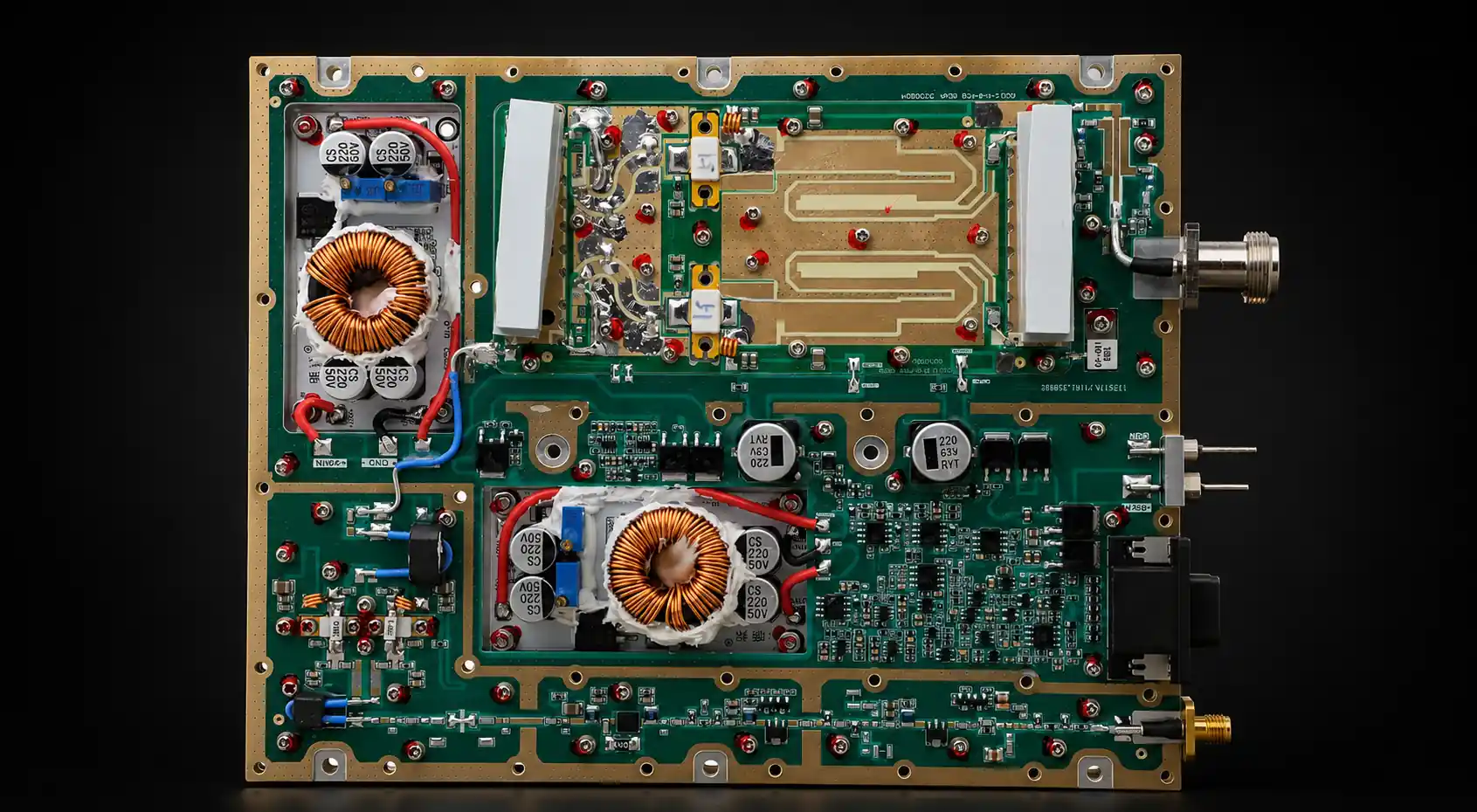
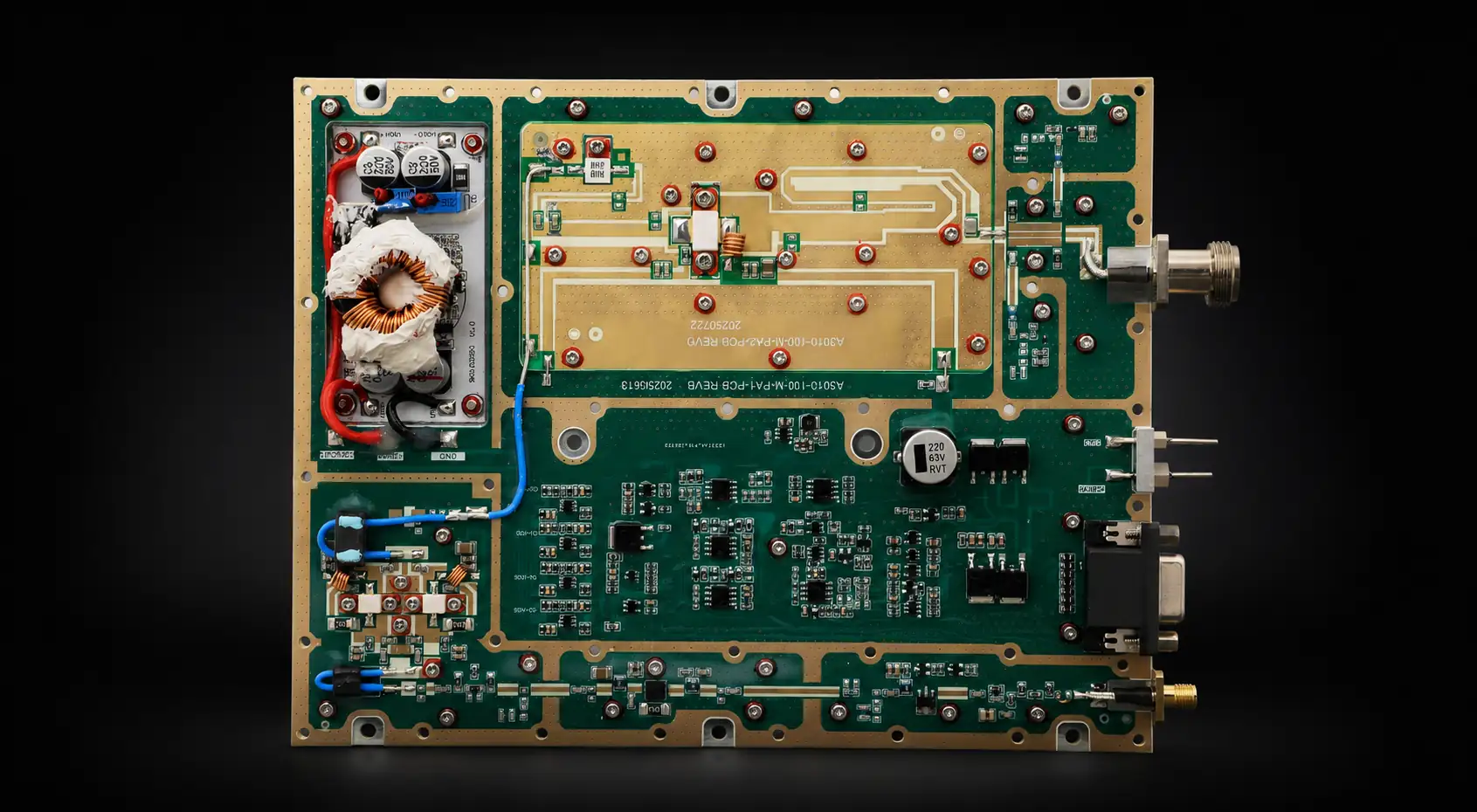
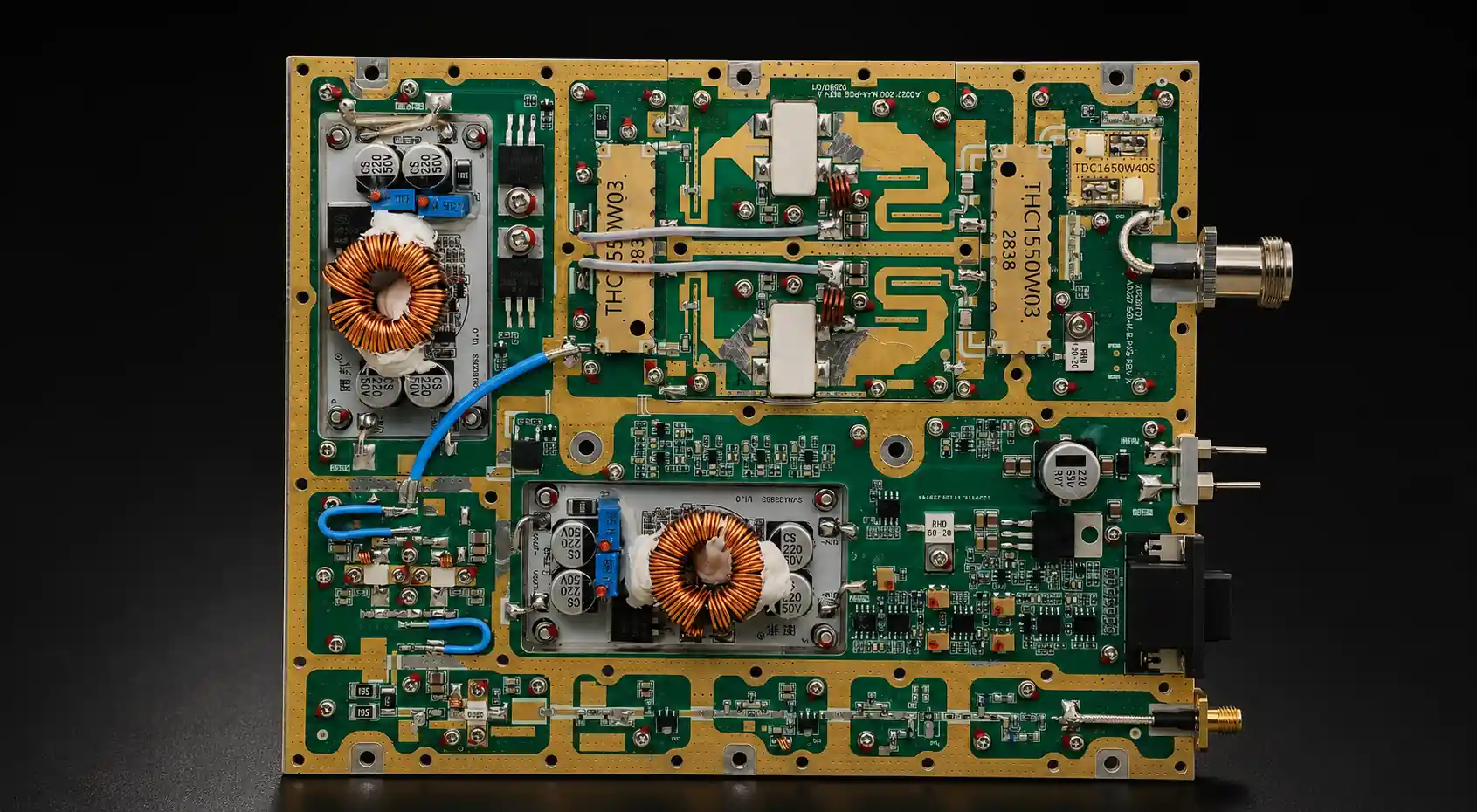
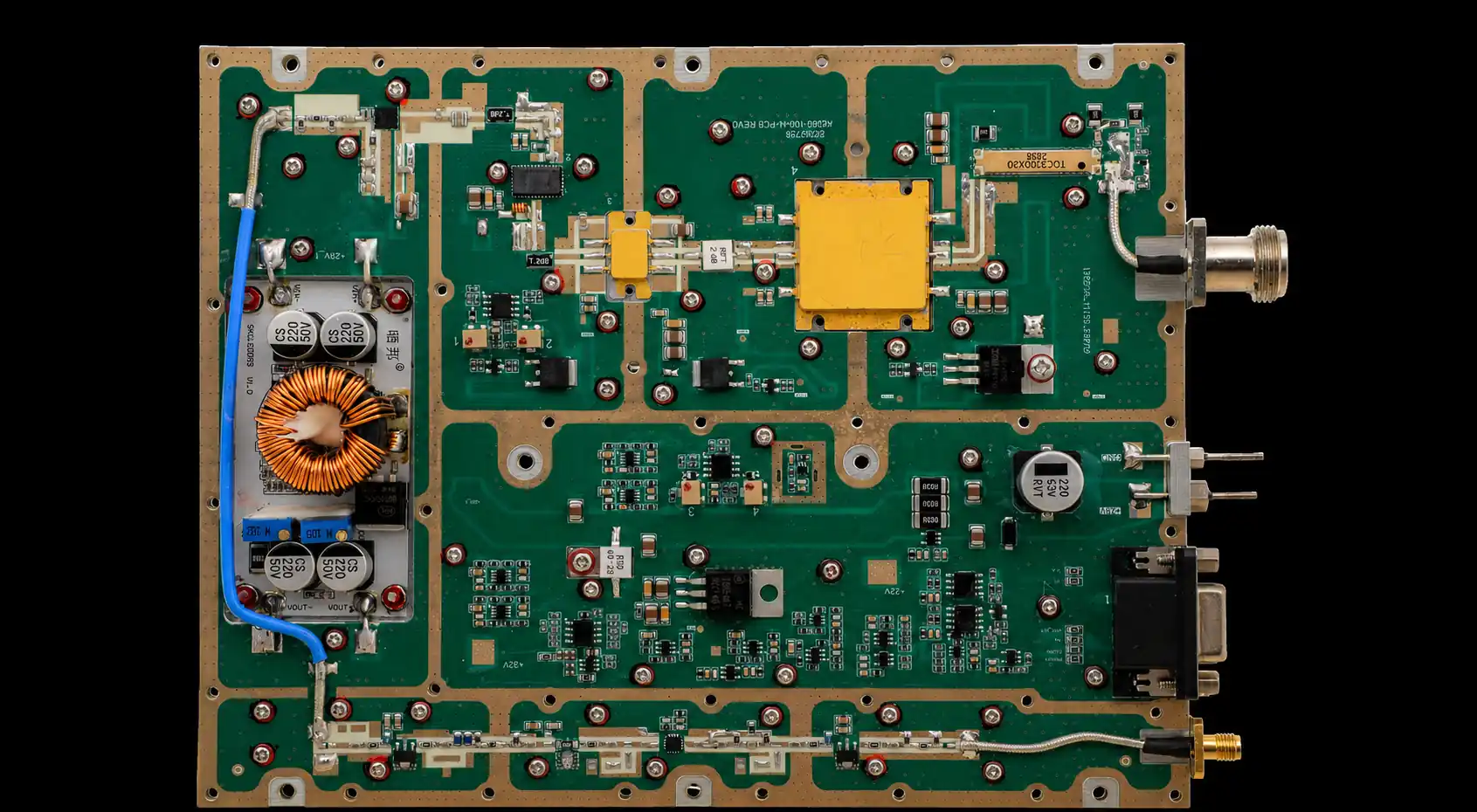
RF Power Amplifier module mounted on a heatsink or cabinet plate, highlighting four reliability dimensions: Thermal Contact, Grounding, Vibration, Corrosion, visually showing how small screws and proper cable routing hold the RF chain reliability together.

RF cable bending can cause power loss and field performance changes in RF Power Amplifier systems because a tight bend, compressed cable path, or stressed connector exit can alter the RF transmission path between the amplifier and the antenna. In a vehicle-mounted C-UAS cabinet, airport perimeter system, border tower, or critical infrastructure installation, the cable is rarely installed as a short, straight laboratory connection. It may pass through cabinet walls, bend around heat sinks, share space with DC wiring, or move under vibration.

That is why RF Power Amplifier Cable Bending should be treated as part of the complete RF chain, not as a simple cable management detail. If bending creates extra loss, local impedance change, or reflected power, a healthy amplifier may appear weak, unstable, or inconsistent after installation. The solution is not to avoid every bend. The solution is to control bend radius, routing pressure, connector strain, and test conditions before blaming the RF module.

1.What Does RF Cable Bending Mean in a Power Amplifier System?

RF cable bending means the feeder cable changes direction in a way that may affect the RF path between the amplifier output and the load. In an RF Power Amplifier Cable Bending review, you are not only checking whether the cable can physically fit inside the cabinet. You are checking whether the cable routing preserves the electrical behavior needed for stable RF delivery.

A feeder cable may connect the module to an antenna, dummy load, combiner, splitter, filter, or test instrument. If the cable is forced around a sharp edge, tied too tightly, or bent near the connector body, the installation path becomes part of the performance result.

RF cable bending inside a power amplifier system showing the RF module, feeder cable, and antenna path as part of the complete RF chain.

Here’s the engineering point: the cable shape can become a hidden test variable.

Where Do Bends Usually Appear?

Bends often appear where mechanical layout leaves little space for RF routing. You may not notice them during bench testing because the cable is usually relaxed and visible.

Common locations include:

  • Cabinet door clearance zones
  • Connector exits near the amplifier output
  • Antenna bracket transitions
  • Vehicle roof feed-through points
  • Tower or pole routing paths
  • Cable bundles fixed with tight ties

These areas deserve inspection before final RF acceptance testing.

Why Is This More Than Cable Management?

This issue matters because RF feeder cable is not the same as a DC power wire. It must preserve impedance, shielding, geometry, and mechanical stability at the same time.

Key Takeaway: RF cable bending should be reviewed as an RF path condition, not only as a neatness or installation issue.

Installation DetailRF RelevanceField Risk
Sharp bend near output portMay disturb impedanceReflected power rise
Cable pressed by cabinet doorMay change shape under closureDifferent test result after assembly
Tight cable tieMay compress dielectric structureLocal loss increase
Unsupported outdoor cableMay move under wind or maintenanceIntermittent fault
Relaxed bend radiusPreserves cable geometry betterMore repeatable RF result

This table helps you separate normal routing from routing that may change field performance.

2.What Risks Arise from Improper RF Power Amplifier Cable Bendingan Cable Appearance?

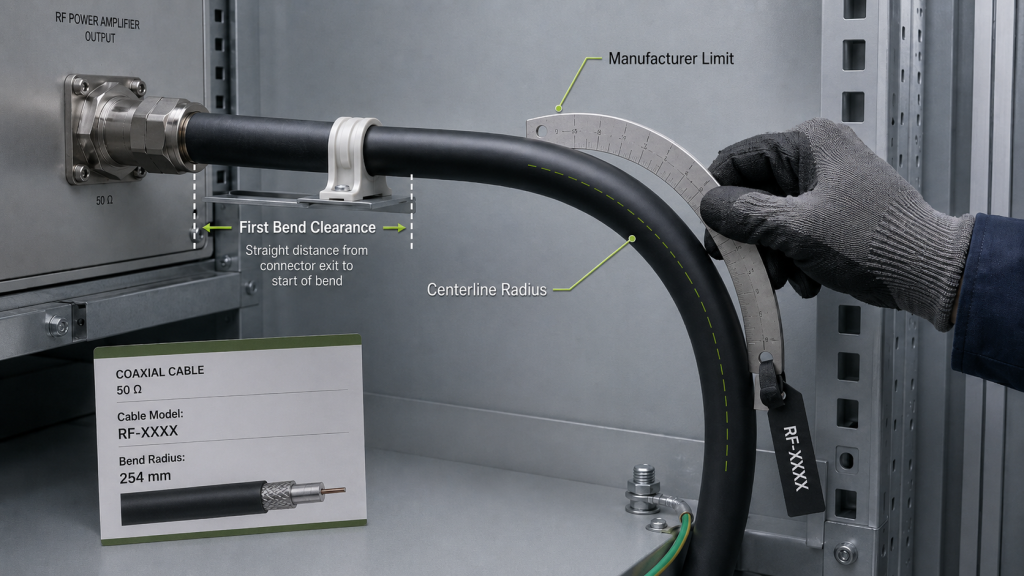
Bend radius matters because a cable can look undamaged while its RF behavior has already changed. In RF Power Amplifier Cable Bending checks, visual inspection alone is not enough, especially when the cable has been squeezed, folded, or held under stress for a long period.

The outer jacket may still look clean. The connector may still feel tight. Yet the internal geometry of the center conductor, dielectric layer, shield, and outer jacket may no longer behave like the original controlled transmission line.

RF cable bend radius inspection showing that a cable can look physically intact while bend stress may still affect RF transmission behavior.

The practical risk is clear: “no visible damage” does not always mean “no RF change.”

What Can Change Inside the Cable?

A tight bend can slightly shift or compress internal layers. That matters because RF cable performance depends on controlled geometry.

Internal changes may include:

  • Center conductor displacement
  • Dielectric compression
  • Shield braid deformation
  • Partial flattening of the cable body
  • Stress concentration near connector exits

The effect may be small at one frequency and much more visible at another.

Why Can the Problem Stay Hidden?

Cable bending problems often stay hidden because the cable still passes a basic continuity check. A multimeter may show connection, but RF transmission can still be affected.

Key Takeaway: A cable that looks physically acceptable may still need RF verification if it has been bent below a safe routing radius.

Check MethodWhat It FindsWhat It May Miss
Visual inspectionJacket damage, crushed areasSmall RF impedance change
Continuity testOpen or broken conductorInsertion loss variation
Connector hand checkLoose connector bodyInternal cable stress
Power testOutput delivery resultExact fault location
VNA or VSWR testReflection and mismatchMechanical root cause without inspection

This table shows why cable appearance should be combined with RF testing during system acceptance.

3.What Happens Inside an RF Power Amplifier Cable When Bent

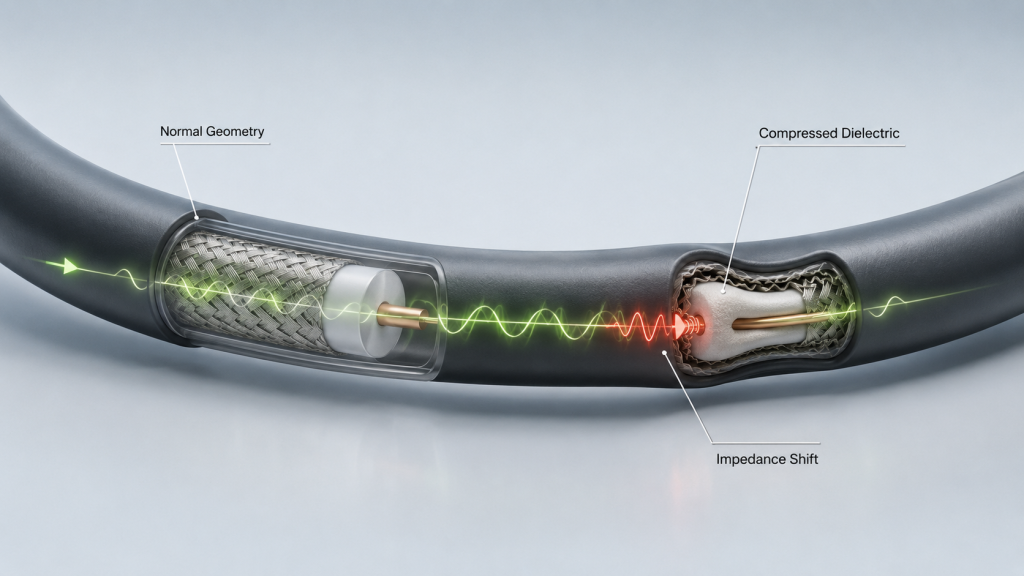
Tight bends create local impedance changes by disturbing the cable geometry that supports a controlled RF transmission path. In an RF Power Amplifier Cable Bending problem, the amplifier may still produce rated output at its port, but the feeder line can introduce a local discontinuity before power reaches the antenna.

Most RF power systems expect a stable 50Ω path. When a small cable section becomes flattened, stretched, or compressed, that section may behave differently from the rest of the cable.

Tight RF cable bend creating a local impedance change in the feeder path, with a 50 ohm path, bend point, and reflected power indication.

Here’s the field reality: the problem may exist in only a few centimeters of cable, but the amplifier can still see its effect.

What Is a Local Discontinuity?

A local discontinuity is a small area where the RF path no longer behaves like the surrounding cable. It can act like a minor mismatch point.

Typical causes include:

  • Bend radius below cable recommendation
  • Cable flattened by mounting pressure
  • Connector exit bent immediately after tightening
  • Cable trapped against a metal edge
  • Repeated bending during maintenance

This is different from a bad cable across its full length.

How Does It Affect the Amplifier?

The amplifier does not know whether the discontinuity comes from a cable bend, connector issue, antenna mismatch, or test setup. It only sees the reflected condition at its output path.

Key Takeaway: A tight bend can create a small impedance discontinuity inside an otherwise normal feeder cable.

Bend ConditionPossible RF EffectSystem Symptom
Smooth large-radius bendMinimal geometry changeStable reading
Tight bend at cable middleLocal impedance changeFrequency-sensitive variation
Bend near connector exitStress at transition pointVSWR fluctuation
Flattened cable sectionHigher insertion lossLower antenna-end power
Repeated flexingProgressive damage riskIntermittent alarm

This table helps engineers look for the physical cause behind electrical symptoms.

4.How to Detect RF Power Amplifier Cable Bending Loss in Field Systems

RF output power can drop after field installation because the installed cable path may add loss that was not present during bench testing. In RF Power Amplifier Cable Bending analysis, you must compare the laboratory RF path with the real cabinet, vehicle, or tower routing path.

In the lab, the cable may be short, straight, and connected to a stable dummy load. In the field, the same cable may be bent around a bracket, pressed by a cabinet panel, or routed through a crowded cable channel.

Bench test and field installation comparison showing how installed RF cable routing can reduce antenna-end output power.

This is where system integrators should pay attention: the amplifier may not have changed, but the delivery path has.

What Changes Between Lab and Field?

The test environment and the installed environment often differ more than expected. That difference can affect antenna-end power.

Common changes include:

  • Longer installed cable path
  • Smaller bend radius
  • Different connector orientation
  • Cable pressure after cabinet closure
  • Nearby heat sources or moving structures
  • Different measurement point

If you only compare final power numbers, you may misread the source of the loss.

How Should You Compare Results?

Compare the same amplifier under controlled cable conditions and installed cable conditions. Record the routing state, not only the module serial number.

Key Takeaway: Field power changes may come from the installed RF path, even when the amplifier module is performing normally.

Test ConditionCable StateWhat It Proves
Factory port testControlled short pathModule output behavior
Bench system testVisible cable pathBasic chain function
Cabinet open testPartially installed pathLayout effect before closure
Cabinet closed testFinal mechanical conditionReal installed performance
Antenna-end testFull RF delivery pathActual field output result

This table shows why field testing must match the final routing condition.

5.What Causes VSWR Issues from RF Power Amplifier Cable Bending

Cable bending affects VSWR and reflected power by creating a mismatch point somewhere inside the output path. In an RF Power Amplifier Cable Bending case, the reflected power alarm may not come from the antenna itself. It may come from a bent feeder section, a stressed connector exit, or a cable path that changes after installation.

RF Power Amplifier protection circuits respond to the reflected condition they see. They do not automatically identify whether the root cause is the antenna, connector, cable, or cabinet layout.

RF cable bending causing a VSWR alarm and reflected power increase in a power amplifier cabinet installation.

Here’s the practical risk: you may replace the wrong component if you do not inspect the cable route.

What Symptoms Point to a Bend-Related Issue?

Bend-related VSWR issues often appear inconsistent because the cable condition changes with position, vibration, or cabinet closure.

Warning signs include:

  • VSWR improves when the cable is straightened
  • Alarm appears after closing the cabinet door
  • One installation fails while another passes
  • Reflected power changes after vehicle movement
  • A new cable fixes the issue without changing the antenna

These symptoms suggest that the mechanical path should be checked.

How Is This Different From Antenna Mismatch?

Antenna mismatch usually stays connected to the antenna or environment. Bend-related mismatch follows cable position and routing pressure.

Key Takeaway: A reflected power alarm may come from the bent cable path, not only from the antenna or load.

SymptomPossible Cable-Bend CauseCheck Method
Alarm after door closureCable compressed by panelTest open vs closed cabinet
VSWR changes after movementCable position shiftedInspect after vibration
Alarm near high bandBend-sensitive frequency effectSweep across frequency
Passes with short test cableInstalled cable path issueCompare cable routing
Intermittent reflected powerStress near connector exitMove cable gently while monitoring

This table gives engineers a practical way to avoid blaming the antenna too early.

6.How to Manage High-Frequency RF Power Amplifier Cable Bending

Higher frequencies are more sensitive to cable bending because smaller physical changes can create more noticeable RF effects. In RF Power Amplifier Cable Bending reviews for C-UAS systems, this matters because many installations include 2.4GHz, 5.8GHz, and wideband ranges such as 2000–6000MHz.

A cable path that seems acceptable at a lower frequency may create more loss, ripple, or reflection at a higher frequency. This becomes more important when one platform carries several RF channels.

High-frequency RF cable bending sensitivity shown with low-band stable response and high-band signal variation caused by cable bend stress.

Here’s the engineering point: “it worked at one band” does not prove it works across every band.

What Makes High-Band Paths Less Forgiving?

At higher frequencies, cable geometry, connector transitions, shielding quality, and installation stress become more visible in measurements.

Sensitive points include:

  • Small impedance variations
  • Connector-to-cable transition quality
  • Shield deformation
  • Bend near antenna feed points
  • Extra loss in longer routes
  • Repeatability across multiple frequencies

You should not judge a high-band installation by low-band behavior alone.

Why Does This Matter for Wideband Systems?

Wideband systems may use several channels and cable paths in one cabinet. A routing problem in one band can create a weak zone even when other bands appear normal.

Key Takeaway: Higher-frequency RF paths need stricter cable bend control because small mechanical changes can produce measurable RF differences.

Frequency SituationBend SensitivityEngineering Action
Low-frequency narrowbandOften more tolerantStill avoid sharp bends
Mid-band RF pathModerate sensitivityVerify after routing
2.4GHz pathHigher sensitivityControl connector exits
5.8GHz pathHigher sensitivityAvoid compression and tight bends
2000–6000MHz widebandFrequency-dependent behaviorSweep across full operating range

This table supports full-band verification instead of single-point assumptions.

7.How Can Cabinet Layout Create Hidden Bend Problems?

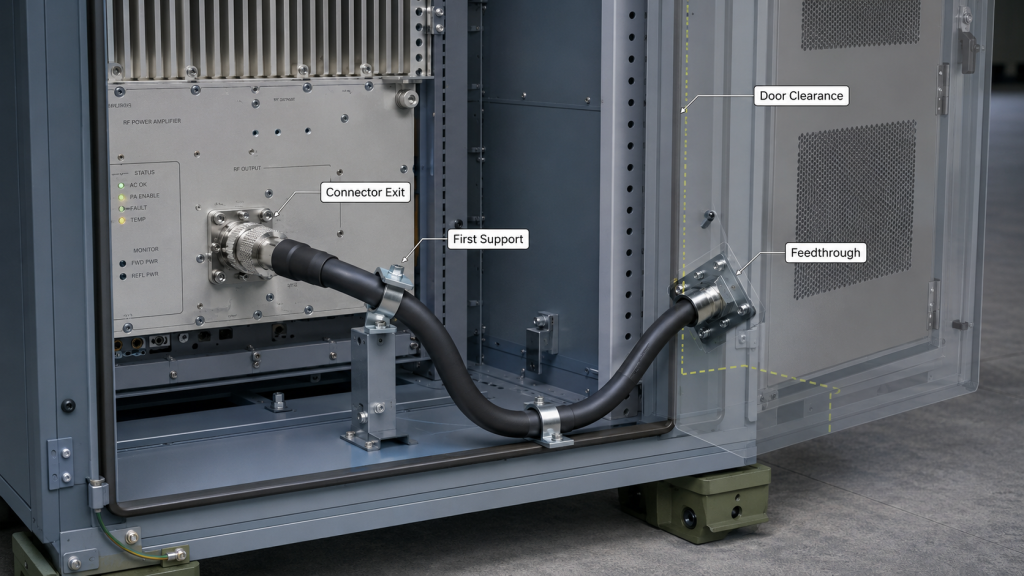
Cabinet layout can create hidden bend problems when the mechanical design leaves too little space for RF cable routing. In an RF Power Amplifier Cable Bending review, you should inspect not only the cable, but also the cabinet geometry that forces the cable into a tight bend.

Many cable problems are not caused by careless installation. They are caused by output ports placed too close to walls, filters installed in awkward positions, or cable exits that conflict with air paths and access panels.

RF cabinet layout showing safe bend radius and sharp bend risk where limited space can force poor feeder cable routing.

This is where system integrators should pay attention: the layout may be creating the fault before the cable is even installed.

Which Layout Details Cause Risk?

RF cables need clearance, bend radius, and strain relief. If those are not planned early, the installer may have no good routing option.

Risky layout details include:

  • Amplifier output port too close to cabinet wall
  • Cable forced to turn immediately after connector
  • RF cable bundled tightly with DC wiring
  • Door panel pressing on feeder line
  • Fan or heat sink blocking routing space
  • Cable exit hole placed at the wrong angle

These issues should be reviewed before production assembly.

How Can You Design Around the Problem?

Good layout leaves mechanical space for the cable’s electrical role. Treat cable routing as part of RF design, not as a final packaging task.

Key Takeaway: Cabinet layout can force cable bending problems, so routing space should be designed before final assembly.

Cabinet FactorBend RiskPrevention Step
Output port near wallImmediate tight bendAdd connector clearance
Crowded RF bayCable compressionSeparate RF routing channel
Door interferenceBend changes after closureTest with door closed
Shared cable bundlePressure from tiesUse controlled supports
Poor feed-through angleLong-term cable stressAlign exit with cable path

This table helps mechanical and RF teams review the same layout before field deployment.

8.Why Do Vehicle and Outdoor Systems Need Extra Bend Control?

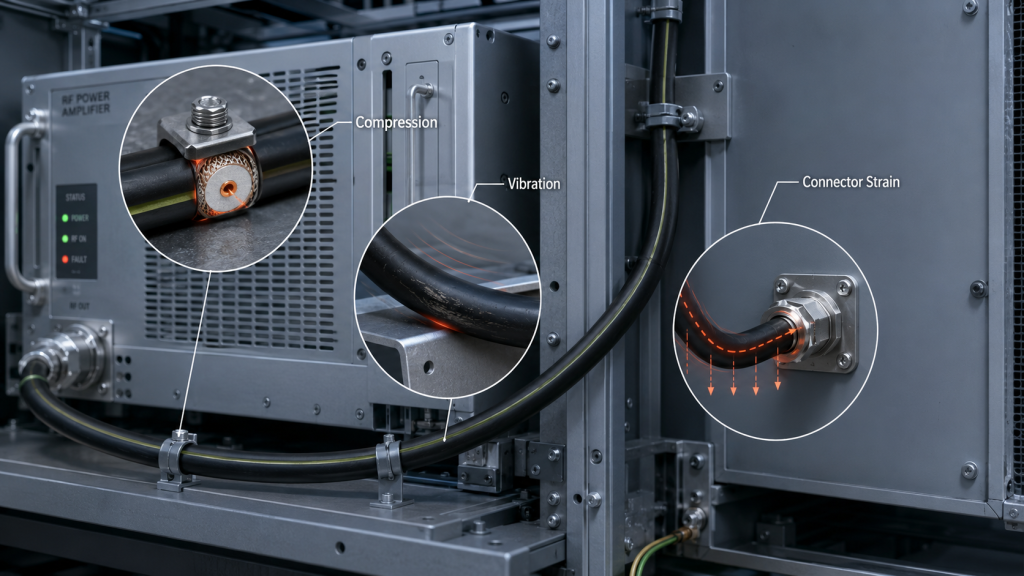
Vehicle and outdoor systems need extra bend control because the cable is exposed to movement, vibration, temperature change, maintenance, and mechanical stress after installation. In RF Power Amplifier Cable Bending checks for airport, perimeter, vehicle-mounted, or fixed-site systems, the bend is not always static.

A cable may look acceptable during installation but move under vehicle vibration, wind load, cabinet service, or repeated door closure. If the bend is close to the connector, the stress can build over time.

Outdoor and vehicle-mounted RF cable installation showing strain relief, service loop, and bend control for long-term field reliability.

Here’s the field reality: a cable route that passes on day one may fail after repeated movement.

What Makes These Systems Different?

Outdoor and mobile platforms experience conditions that a lab bench does not reproduce. The cable route must survive the operating environment.

Typical stress sources include:

  • Vehicle vibration
  • Roof or mast movement
  • Wind on exposed cable runs
  • Temperature cycling
  • Maintenance pull force
  • Repeated cabinet opening
  • Cable rubbing against brackets

These stresses can turn a bend into a long-term failure point.

How Should You Control Long-Term Stress?

Use strain relief, routing supports, and adequate service loops. Do not allow the connector to carry cable weight or vibration stress.

Key Takeaway: In vehicle-mounted and outdoor systems, cable bending must be controlled for long-term mechanical stress, not only initial installation.

Field ConditionCable RiskPractical Control
Vehicle vibrationRepeated flexingAdd support and strain relief
Outdoor windCable movementSecure with proper spacing
Temperature cyclingMaterial expansion stressAvoid rigid over-tight fixing
Maintenance accessCable pulled or twistedLeave service loop
Tower routingAbrasion and pressureProtect contact points

This table shows why field environment should influence cable routing decisions.

9.How to Prevent RF Power Amplifier Cable Bending Loss During Installation

Engineers can check and prevent cable-bend loss by testing the cable in the same routing condition used in the final installation. In RF Power Amplifier Cable Bending troubleshooting, you should not only remove the cable, straighten it, and test it on a bench. That may hide the exact condition causing the field problem.

The better approach is to compare controlled cable states: installed open cabinet, installed closed cabinet, alternative cable, and short verified test cable.

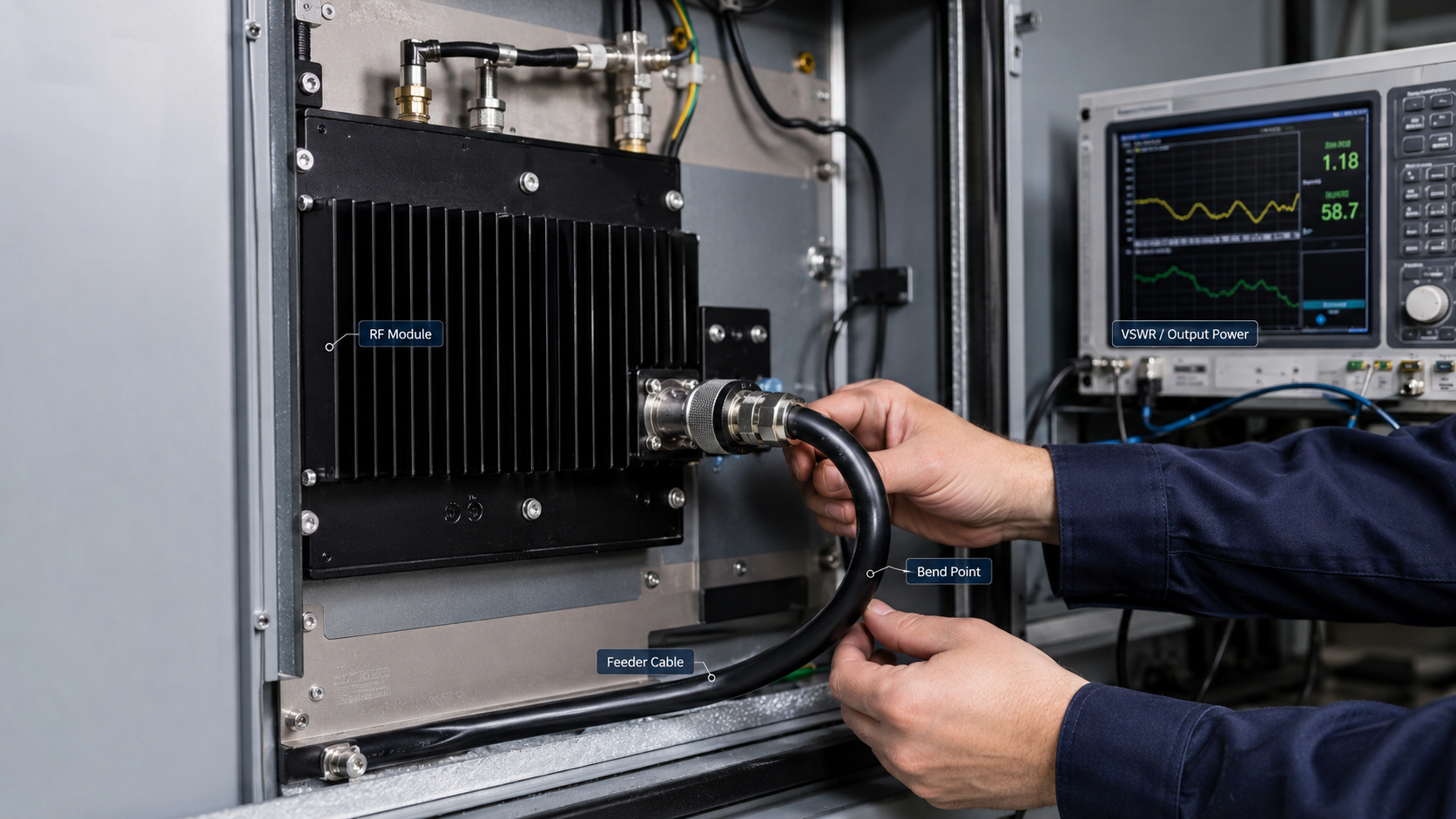
Engineer checking installed RF cable routing while monitoring VSWR and output power to prevent cable-bend loss in the final system route.

Here’s the practical point: reproduce the mechanical condition before judging the electrical result.

What Should You Inspect First?

Start with the simplest physical checks before replacing RF modules or antennas. Many routing faults are visible once you know where to look.

Check for:

  • Sharp bends near connector exits
  • Flattened or kinked cable sections
  • Cable trapped by cabinet doors
  • Ties tightened directly over coaxial cable
  • Cable rubbing against metal edges
  • Cable path changes after vehicle movement
  • Outdoor cable hanging under tension

Document the routing state with photos during testing.

What Tests Help Confirm the Cause?

Use comparison tests that isolate the cable path from the amplifier. If the result changes with routing, the cable path is part of the fault.

Key Takeaway: Cable-bend loss should be checked under real routing conditions, not only with the cable removed from the system.

Check StepPurposeGood Practice
Inspect bend radiusFind mechanical stressCheck full route, not only ends
Compare open vs closed cabinetFind compressionMeasure both states
Swap verified cableIsolate cable faultKeep same load and frequency
Sweep frequencyFind band-sensitive lossTest high-frequency bands carefully
Record cable pathSupport repeatabilitySave photos and test notes

This table gives engineers a repeatable troubleshooting path before blaming the RF Power Amplifier.

10.How Do Suppliers Reduce Cable-Bending Misjudgment?

Suppliers reduce cable-bending misjudgment by helping customers separate real amplifier performance from installation-induced RF path problems. In RF Power Amplifier Cable Bending discussions, a good supplier should not simply say the module is rated at a certain wattage. They should help you understand where that power is measured and how the installed RF path affects the final result.

This is especially important when the same module passes factory testing but appears weaker after integration. The difference may come from cable routing, connector condition, antenna match, load position, or measurement method.

RF supplier engineering review showing power amplifier module, feeder cable, connector, antenna path, and test report used to separate module performance from installation-induced cable issues.

Here’s the engineering value: better diagnosis protects both the buyer and the supplier from the wrong conclusion.

What Should You Ask the Supplier?

Ask for information that connects module data with system integration reality. A useful supplier can help you review the RF path, not only the power label.

Questions to ask include:

  • Where was output power measured?
  • What cable and load were used during testing?
  • Was reflected power monitored?
  • Was the test done across the full band?
  • Are connector and cable routing limits discussed?
  • Can the supplier support repeatable test setup guidance?

These questions reduce uncertainty during field acceptance.

What Support Matters Most?

For wideband RF Power Amplifier modules used in C-UAS systems, cable bending should be evaluated as part of the full RF chain. The module, feeder cable, connector, antenna, and installation path work together in the final field result.

Key Takeaway: A capable RF supplier helps customers identify whether a field issue comes from the module or from the installed RF path around it.

Supplier SupportWhy It MattersBuyer Benefit
Port power dataConfirms module baselineAvoids guessing
Full-band verificationShows frequency behaviorFinds weak zones
Reflected power monitoringDetects load stressReduces field failure risk
Integration guidanceConnects module to systemImproves installation success
Repeatable test setupMakes results comparableSupports acceptance review

This table shows why engineering support is part of reliable RF module sourcing.

FAQ

Can I bend RF cable if the system is low power?

Yes, but the bend still needs control. Lower power may reduce thermal and stress risk, but impedance change, insertion loss, and repeatability problems can still appear, especially at higher frequencies.

What’s the best way to check RF cable bend radius?

The best method is to follow the cable manufacturer’s bend radius guidance and verify the installed RF path with power and VSWR tests. You should test the cable in the final routing condition, not only when it is straight on a bench.

How do I know if cable bending is causing VSWR alarms?

A bend-related issue is likely if VSWR changes when the cable is moved, straightened, replaced, or tested with the cabinet door open versus closed. These symptoms suggest the cable path should be inspected before replacing the antenna or amplifier.

Can cable bending affect only some frequencies?

Yes, frequency-sensitive effects are common. A cable route may look acceptable at lower frequencies but create more loss or reflection at higher bands such as 2.4GHz, 5.8GHz, or 2000–6000MHz paths.

What’s the best prevention step during cabinet design?

The best prevention step is to reserve enough connector clearance, cable routing space, and strain relief before final cabinet layout. RF cable routing should be reviewed together with module placement, antenna ports, thermal paths, and maintenance access.

Conclusion

RF cable bending affects RF Power Amplifier field performance because the feeder cable is part of the output delivery path, not an isolated accessory. This article explained why bend radius matters, how tight bends can create local impedance changes, why antenna-end power may drop after installation, how VSWR alarms can come from the cable path, and why high-frequency, vehicle-mounted, outdoor, and cabinet-based systems need stricter routing control.

RF SKYPOWER can support system integrators with factory-direct RF Power Amplifier modules, C-UAS core components, practical RF chain awareness, and repeatable test setup thinking. If your field result changes after installation, maintenance, or cabinet closure, the right next step is not to blame one component too quickly. Review the module, feeder cable, connector, antenna, cabinet layout, and measurement point as one RF system.

For verified RF module support and engineering-focused sourcing, contact us today.

Controlled RF energy should be measured at the module, protected through the cable path, and delivered predictably in the field.