
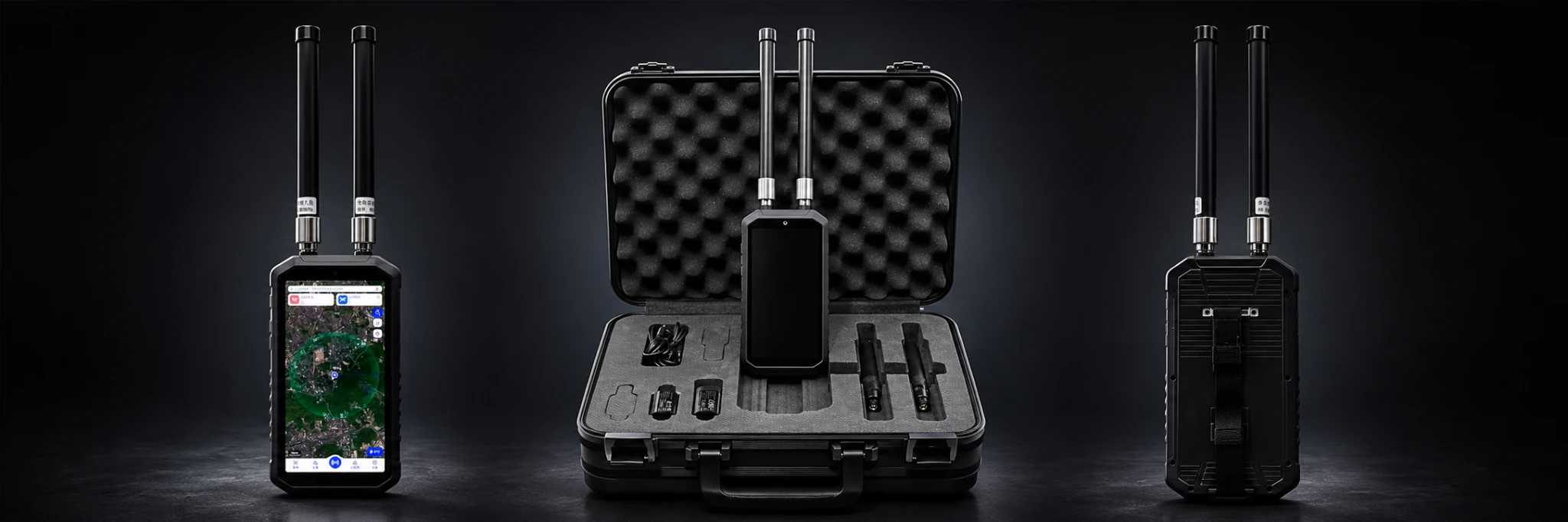

A drone detection device specification should define what the receiver detects, what it can identify, what the operator sees, and what the system records. Distance, response-time, and positioning figures need the target model, equipment configuration, and test conditions that produced them.
Start with the aircraft your team expects to encounter and the information operators need. Those requirements form a practical basis for comparing equipment and reviewing field demonstrations.
1. What Should a Drone Detection Device Specification Actually Include?
Define the operator’s job before examining the datasheet. A mobile patrol may need fast alerts, model identification, displayed distance, and a location view. A permanent monitoring station may also need remote notifications and integration with a control platform.
Use the same fields for every candidate so engineers and buyers can compare like-for-like outputs.
| Specification area | Information supplier must state | Critical conditions | Evidence to request |
|---|---|---|---|
| RF reception | Frequency bands, signal families, scanning method, and supported protocols | Antenna configuration, signal type, RF environment | Frequency specifications and supported-signal list |
| Detection range | Distance figures and the detection result associated with each figure | Drone model, altitude, terrain, receiver position, interference | Field-test video and recorded test conditions |
| Alert response time | Time from a defined signal-onset reference to the operator alert | Time synchronization, signal level, scanning configuration | Timestamped source event and alert record |
| Identification | Drone brands, models, identifiers, and decoded information fields | Protocol compatibility and firmware version | Target-model matrix and identification examples |
| Geolocation | Reported positions, RF bearings, and estimated positions | Position source, signal protocol, locating method | Coordinate examples and source definitions |
| Concurrent targets | Number of targets detected simultaneously | Target mix, update behavior, signal conditions | Multi-target demonstration and product specification |
| Event logs | Recorded fields, retention, search, and export methods | Recording configuration, software version, storage | Sample event records and export files |
| False-alert performance | Classified false-alert count or rate and filtering controls | Monitoring duration, RF conditions, alert rules | Classified event records, monitoring time, and alert settings |
| Firmware and target database | Firmware version, target database revisions, update method | Software build and protocol database version | Release records and update documentation |
| Hardware and power | Weight, display, battery, charging, interfaces, accessories | Operating mode, screen settings, duty cycle | Hardware specifications and runtime conditions |
| Environmental and commercial support | Operating temperature, protection requirements, service, supplied items | Deployment environment and delivery configuration | Datasheet, delivery list, and relevant technical records |
Save the specification revision and firmware build with each candidate’s evidence.
2. RF Coverage: Frequency Bands, Supported Signals, and Detection Range
List receive-frequency bands and decodable signal families separately. For each family, show the compatible drone models, antenna arrangement, scan settings, and fields available on screen.
Define the range measurement
Associate each detection-distance figure with an observable result:
- An initial detection alert.
- Stable identification of the drone model.
- Available target identity or location information.
Record the aircraft model, altitude, detector placement, antenna orientation, terrain, and RF conditions alongside the distance figure.
HZ-HD03 outdoor detection example
In an RF SKYPOWER outdoor demonstration, the HZ-HD03 Handheld Drone Detector identifies a DJI Mini 5 Pro while its screen displays a target distance of approximately 1,778 m (1.78 km).
The video shows the aircraft entry, identity-related fields, altitude, and location information on the device. For a comparable field record, pair that observation with the flight conditions and detector setup.
3. Identification: Drone Models, Serial Numbers, and Protocol Support
For each priority aircraft, build a target-model matrix with its manufacturer, model, received signal or protocol, identifier type and value, and available position fields. Keep the detector firmware build as configuration metadata for the test.
Identify the source of each serial number
Different signal families carry different identifiers. A decoded proprietary drone link may expose an aircraft-related identifier. Standard Remote ID may broadcast an aircraft serial number or session ID; a retrofit Remote ID broadcast module uses the module’s own serial number.
Label the identifier type alongside its value in the target matrix and event records.
Concurrent target detection and operator workflow
The HZ-HD03 supports simultaneous detection of 12+ drone targets. Its multi-target interface allows operators to inspect individual detections during a busy monitoring period.
In RF SKYPOWER’s three-drone field demonstration, the screen shows Current: 3. The operator opens target details, including the DJI Mini 5 Pro entry, to view its identity-related information.
For a project comparison, state the required concurrent-target count together with the per-target fields and expected list-update behavior.
Whitelist management and target identification
Target identifiers also support alert management. In RF SKYPOWER’s HZ-HD03 demonstration, an operator adds a recognized DJI identifier to the whitelist. The video shows the whitelist interface alongside live target information on two handheld units.
A whitelist entry can include the drone model, ID, and validity period. When the HZ-HD03 detects a whitelisted ID, it suppresses the corresponding alarm, allowing operators to focus on other alerts.
4. Geolocation: Drone Position, Controller Location, and Position Accuracy
Every reported position or direction needs a defined source and reference. Drone coordinates, controller and takeoff locations, RF bearings, and estimated positions answer different operational questions.
| Data output | Data source | Object represented | Availability condition | Buyer verification |
|---|---|---|---|---|
| Drone coordinates | Decoded telemetry or identification signal | Drone position | Relevant position fields are received and decoded | Compare coordinates with time-matched target records |
| Standard Remote ID control-station coordinates | Standard Remote ID broadcast | Control station | Applicable broadcast messages are received and decoded | Inspect decoded fields and coordinate labels |
| Remote ID broadcast-module takeoff coordinates | Remote ID broadcast module | Aircraft takeoff location | Broadcast-module messages are received and decoded | Confirm the reported location type |
| RF bearing | Direction-finding receiver or antenna system | Direction of arrival relative to the detector | Direction-finding hardware and processing are included | Compare bearing with known target geometry |
| Estimated target or controller position | RF geolocation method | Position estimated by the detection system | Required measurements and locating configuration are available | Review locating method and position-error records |
| Detector coordinates | Receiver GNSS or configured site coordinates | Detector location | Receiver position is established | Compare with surveyed or independently recorded detector coordinates |
Under the FAA Remote ID framework, a Standard Remote ID drone broadcasts control-station location information; a Remote ID broadcast module reports its takeoff location. Use those exact field definitions when reviewing maps or event records.
For supported decoded drone links, the HZ-HD03 displays aircraft and controller-related location information on its map and trajectory views. Operators can inspect the reported positions and movement directly on the handheld screen.
Define positioning accuracy and update behavior
For a location result, preserve its coordinate source, reference system, timestamp, and update interval. A numerical positioning-accuracy specification should identify:
- Reference coordinates and time alignment.
- Position-error metric and measurement units.
- Sample count and test environment.
- Receiver configuration, coordinate update rate, and data age.
Mean error and 95th-percentile error describe different parts of the result distribution. Name the metric beside the reported number.
5. Event Logs, Raw Data, and Export Evidence
Event records let operators revisit a detection after the aircraft has left the area. The specification should identify which fields are stored, how operators search them, how long they are retained, and the formats available for export.
The HZ-HD03 event interface shows drone ID, detection time, duration, operating frequency band, and trajectory. Its Statistics view summarizes events over selectable 30-day, three-month, and one-year periods, including event counts, durations, frequently observed IDs, and drone models.
For the RFQ, request a sample event export and its field definitions. Check which fields it contains, including detector ID, firmware build, alert status, location data, and operator actions. Compare matching fields with the corresponding on-screen event.
Separate event records, decoded messages, and raw RF data
Specify which of these record types the device can retain or export:
- Event summaries document detections, alerts, and the target details shown to operators.
- Decoded-message records contain fields extracted from recognized protocols.
- RF or spectrum captures support analysis of the received signal.
The HZ-HD03 includes Signal Parse and Signal Capture interfaces. Ask which data each function saves and which file formats the delivered configuration can export. Pair a sample file with the corresponding screen record.
Distinguish alert filtering from false-alert performance
Whitelist rules control alarms for recognized IDs. To assess false-alert performance, count classified false alerts over a stated monitoring period, such as false alerts per monitored hour, and record the RF environment and alert settings. Keep the whitelist configuration with that result.
6. Firmware Updates and Supported-Target Lifecycle
Firmware and target-database revisions affect the technical configuration used to recognize aircraft and display decoded fields. Keep the delivered software version with the target-model matrix and its supporting demonstrations.
The procurement specification should include:
- Delivered firmware build and target-database revision.
- Update method and release documentation.
- Technical support and maintenance arrangements.
- Reference outputs for the aircraft models that matter to the project.
The HZ-HD03 provides device-controller firmware updates, detection-band selection, drone timeout settings, and an adjustable history period. Record these settings alongside the firmware build used in each test.
After a major update, compare the selected reference aircraft’s alert, ID, position, and event fields with the previous record. Store the result under the new version.
7. Battery, Environmental Ratings, and Service Conditions
For a patrol unit, verify its weight with antennas attached and screen readability outdoors. Measure battery runtime during continuous RF monitoring with the display active; note brightness, network use, temperature, recharge time, and supplied power accessories. Compare operating-temperature and ingress-protection ratings with the intended deployment conditions.
HZ-HD03: A Portable Passive RF Detection Option
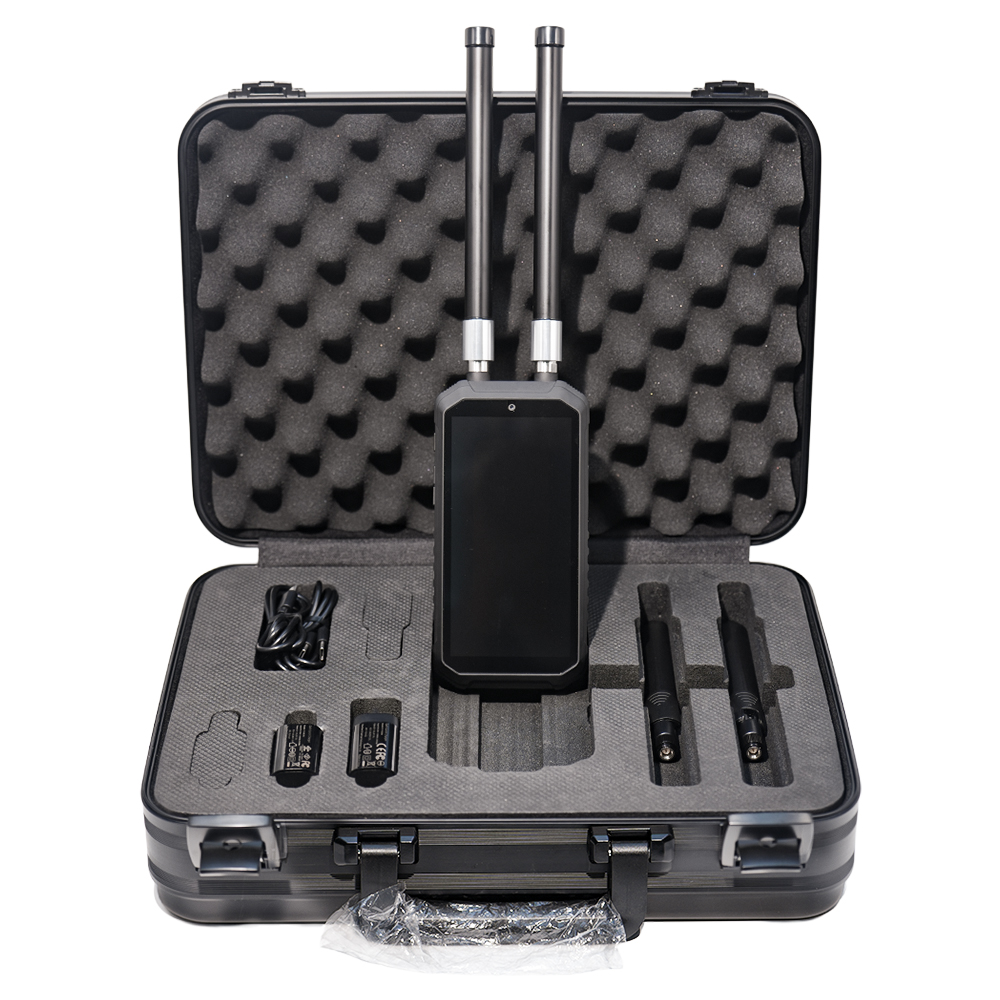
RF SKYPOWER HZ-HD03 Handheld Drone Detector
The HZ-HD03 Handheld Drone Detector combines passive RF/SDR reception, target identification, and on-device map and event views in a compact handheld unit for patrols and temporary deployments.
Published hardware specifications
- Main-unit dimensions: 177 × 89 × 30 mm.
- Main-unit weight: approximately 580 g, excluding fiberglass antennas.
- Display: 6.0-inch touchscreen.
- Charging: Type-C connection, with an 18 W USB fast-charging adapter listed in the standard delivery kit.
- Network and storage options: Wi-Fi, 4G nano-SIM, and Micro SD expansion.
Operator functions
Target identification, decoded aircraft and controller information, trajectory and map views, analog FPV feed monitoring, historical event records, and whitelist/blacklist management.
Specify the required runtime, antenna set, environmental conditions, accessories, and maintenance support in the RFQ.
8. How to Compare Device Specifications Before Issuing an RFQ
Use the same target models, required outputs, and operating conditions for each candidate. Assign a review status to every priority specification field:
- Comparable: Matching requirements and supporting evidence are available for the field being evaluated.
- Partially Comparable: Supporting evidence covers part of the required output, with the remaining fields under review.
- Evidence Pending: The supplier states a specification, but the supporting record has not been reviewed.
Hold evidence-pending fields out of supplier scoring until the supporting records are reviewed. For partially comparable fields, score only the conditions and outputs that match.
Attach the completed table from Section 1 to the RFQ, with a review status, evidence reference, and next supplier action beside each priority field.
For example, time-matched field footage can support a demonstrated model-identification result. A positioning-accuracy figure is assessed against its coordinate reference, time alignment, and stated error metric.
If the project is choosing among handheld RF equipment, fixed sensors, radar, or a combined architecture, the guide to choosing a drone detector covers that system-level decision.
Conclusion
A useful specification comparison describes the same operator results under comparable conditions. A range figure without test details or a map coordinate without its source stays under review. This checklist cannot establish a site’s detection range, positioning tolerance, or acceptance limits on its own.
Before issuing the RFQ, finalize the target-model list, required outputs, deployment conditions, and evidence each supplier must provide. Set range and positioning acceptance criteria for the specific project.
Request HZ-HD03 Specifications and Engineering Review
For mobile passive RF detection projects, RF SKYPOWER can provide HZ-HD03 technical details and relevant field demonstrations. Share the drone types you expect, the deployment environment, required ID and location fields, event-record needs, quantity, destination, and project schedule. Our engineering team can review the configuration and prepare the corresponding procurement information.