
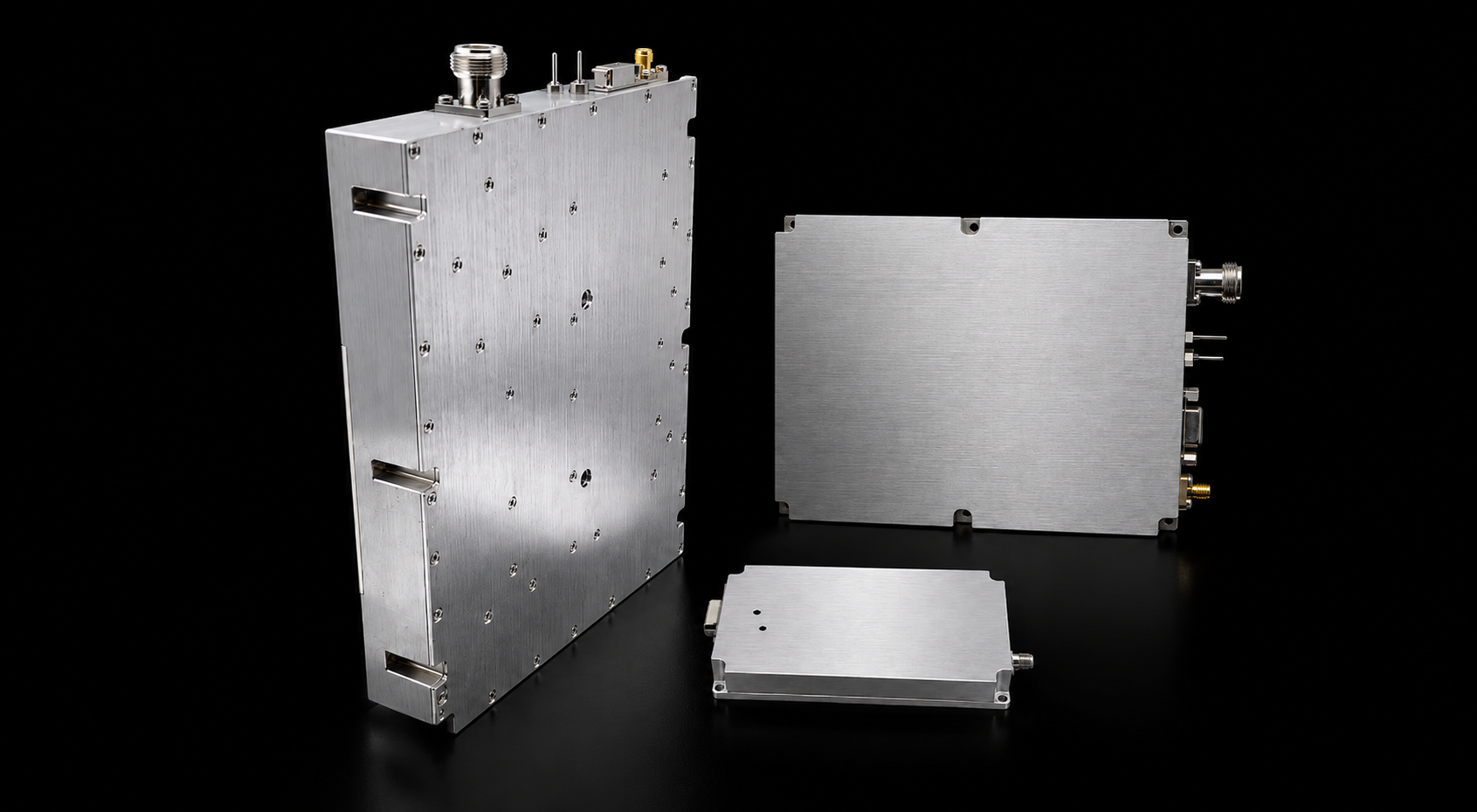
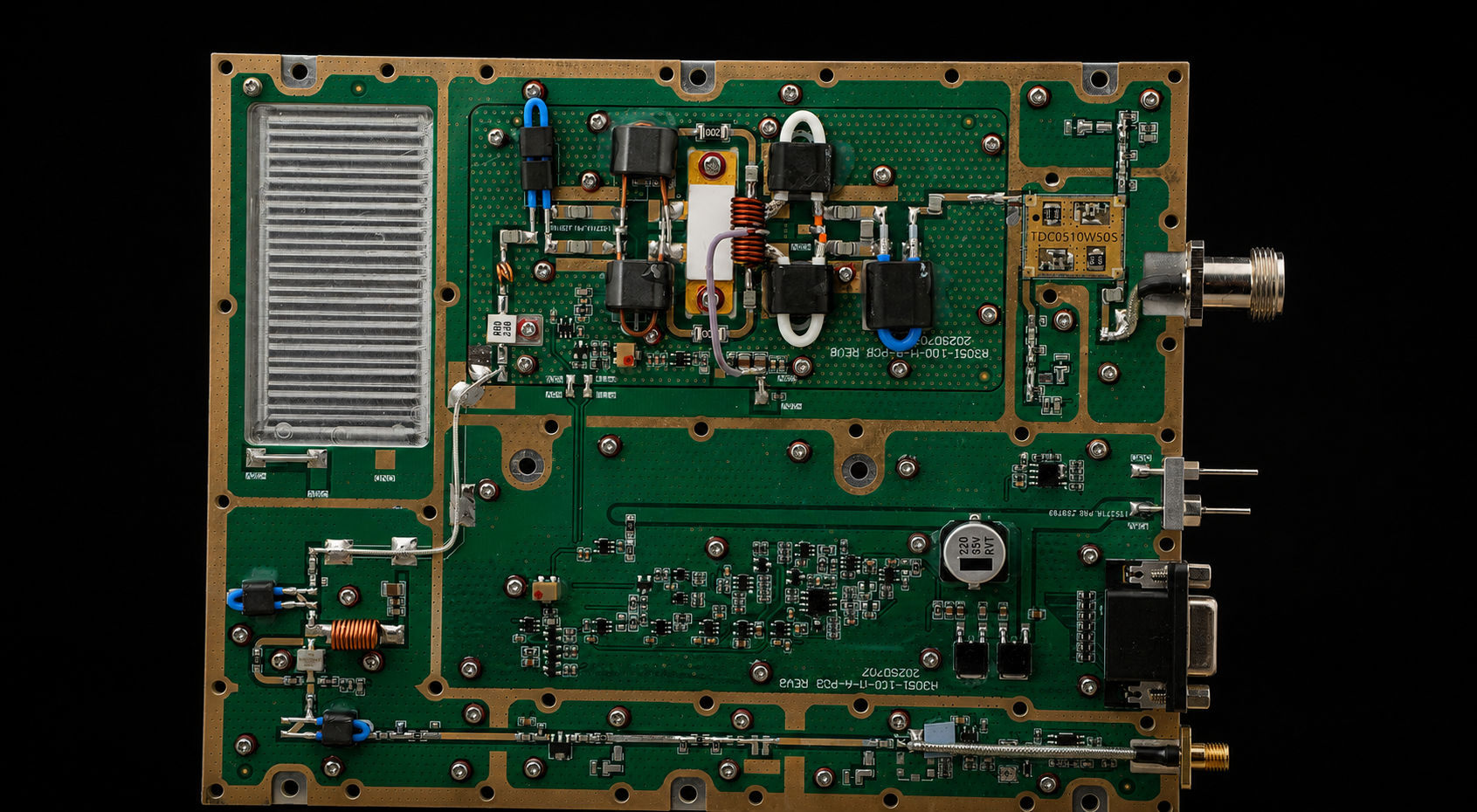
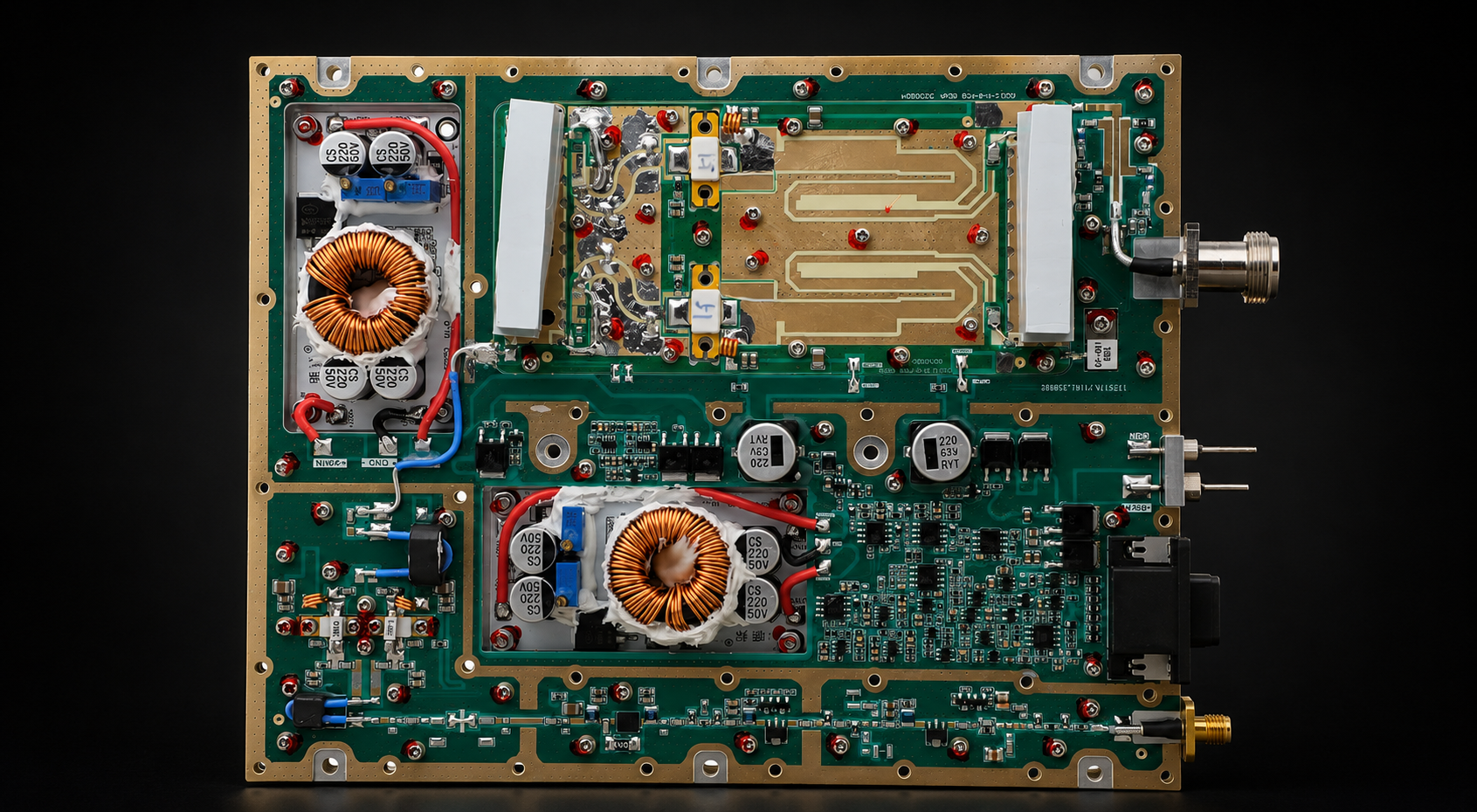
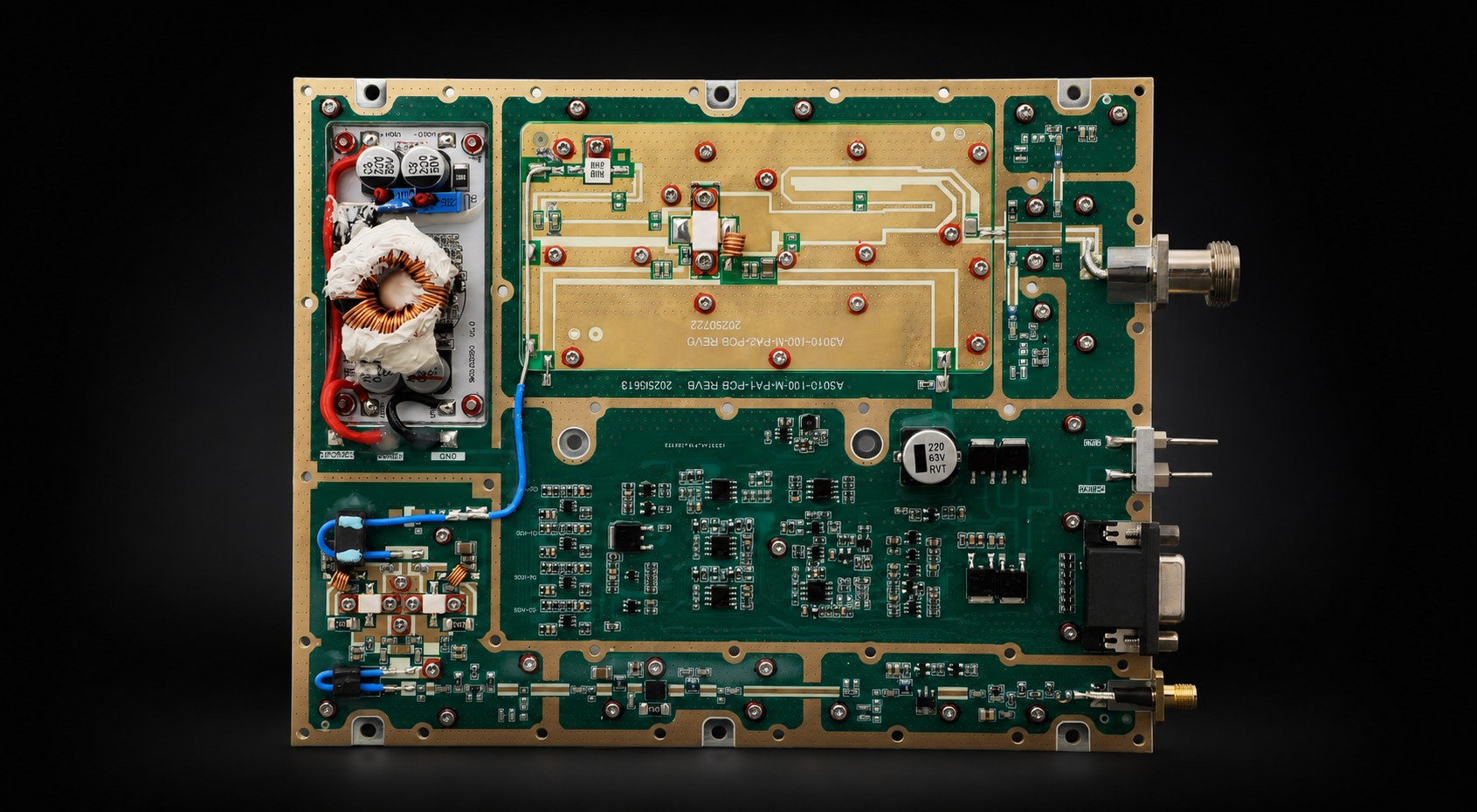
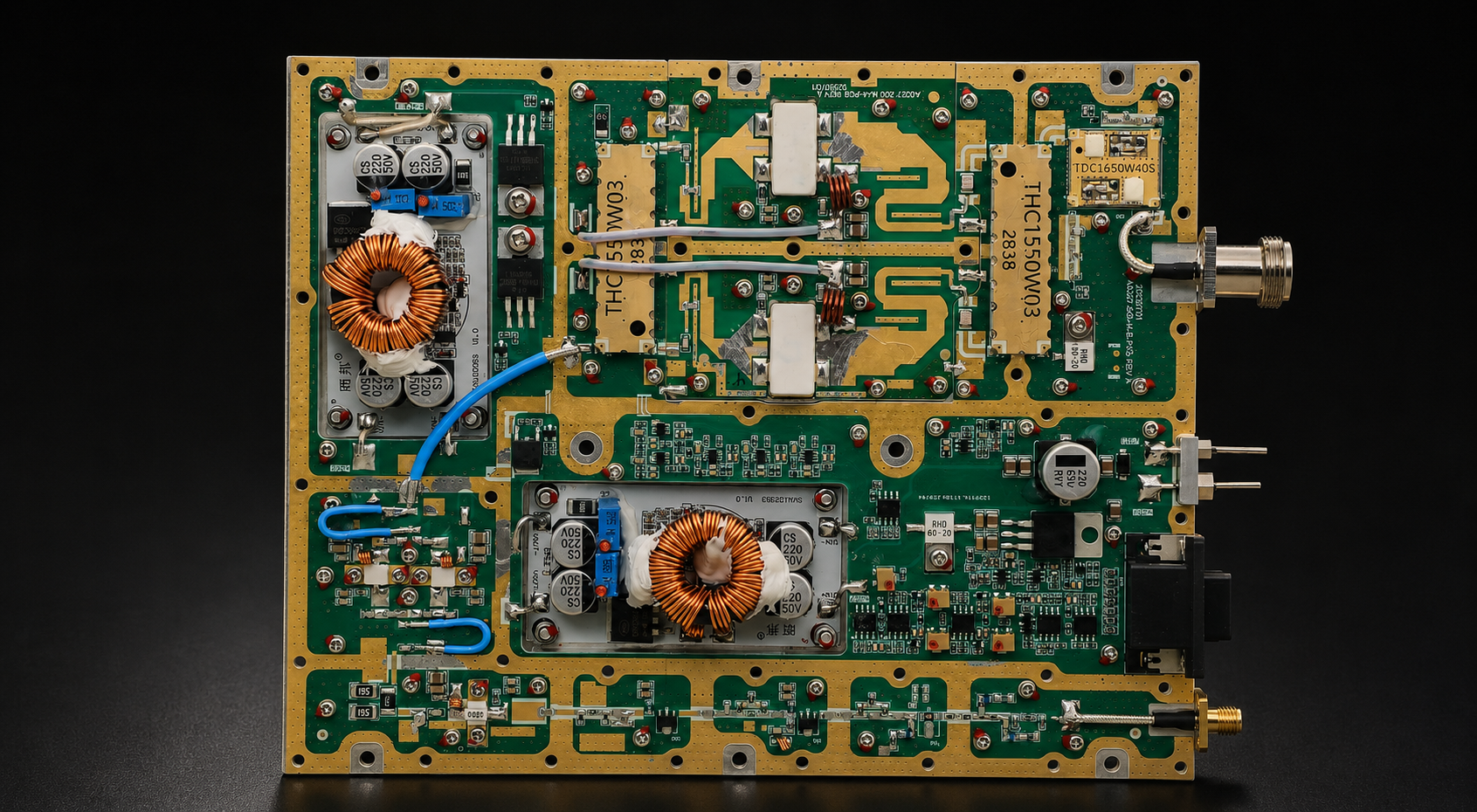
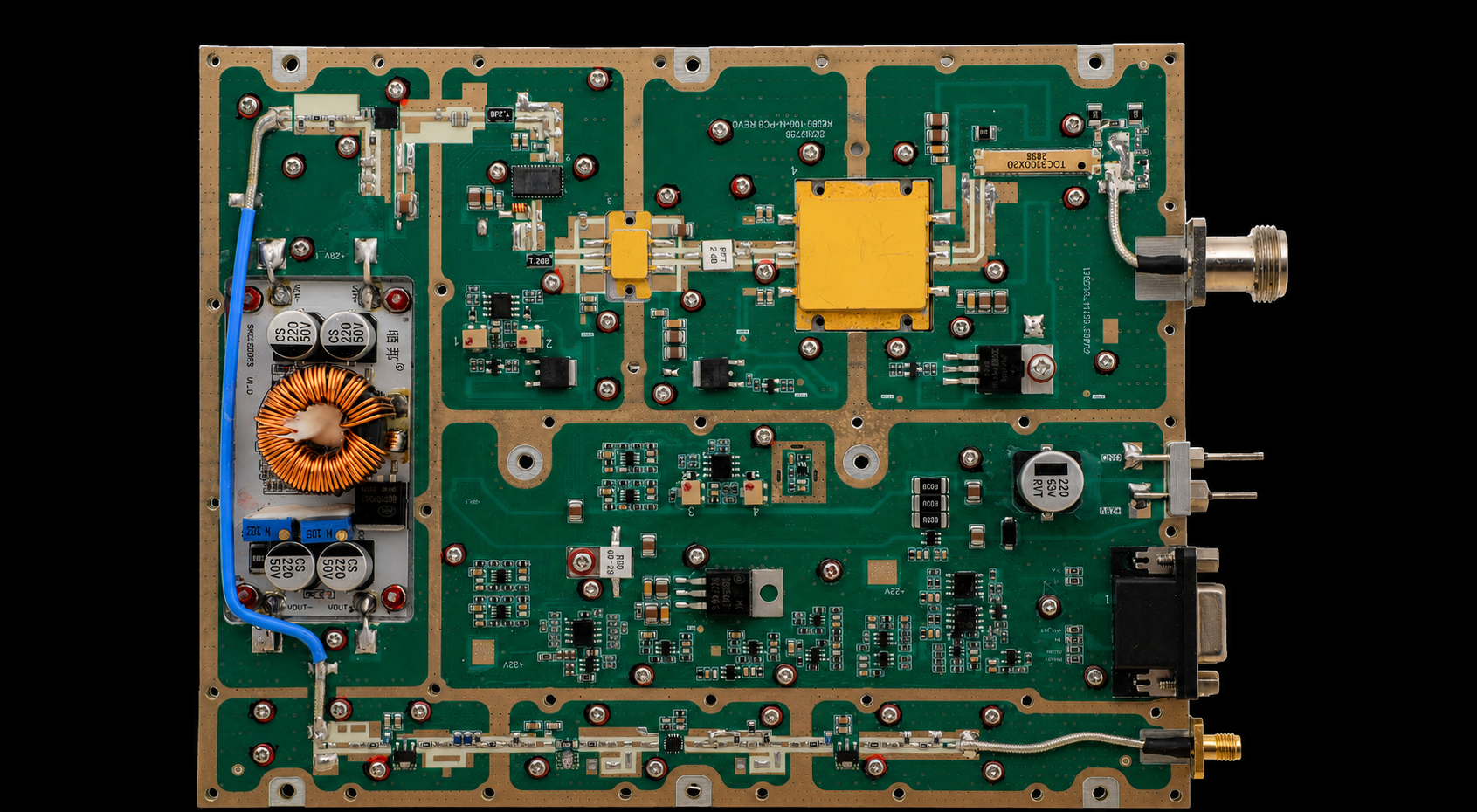
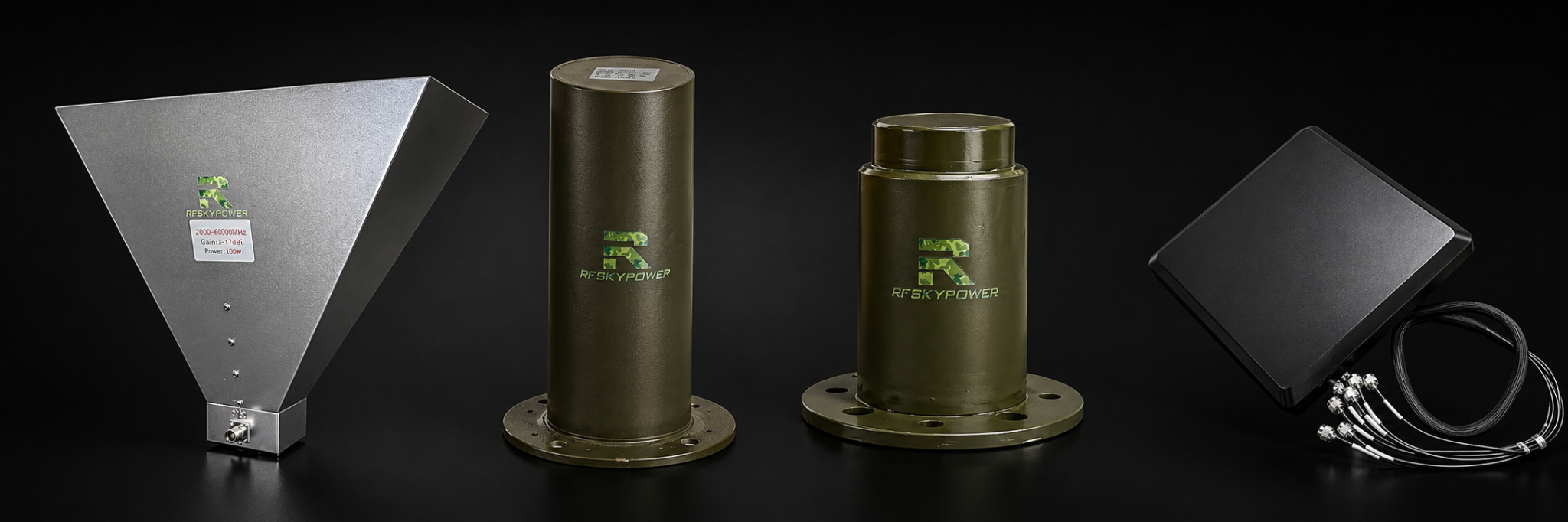
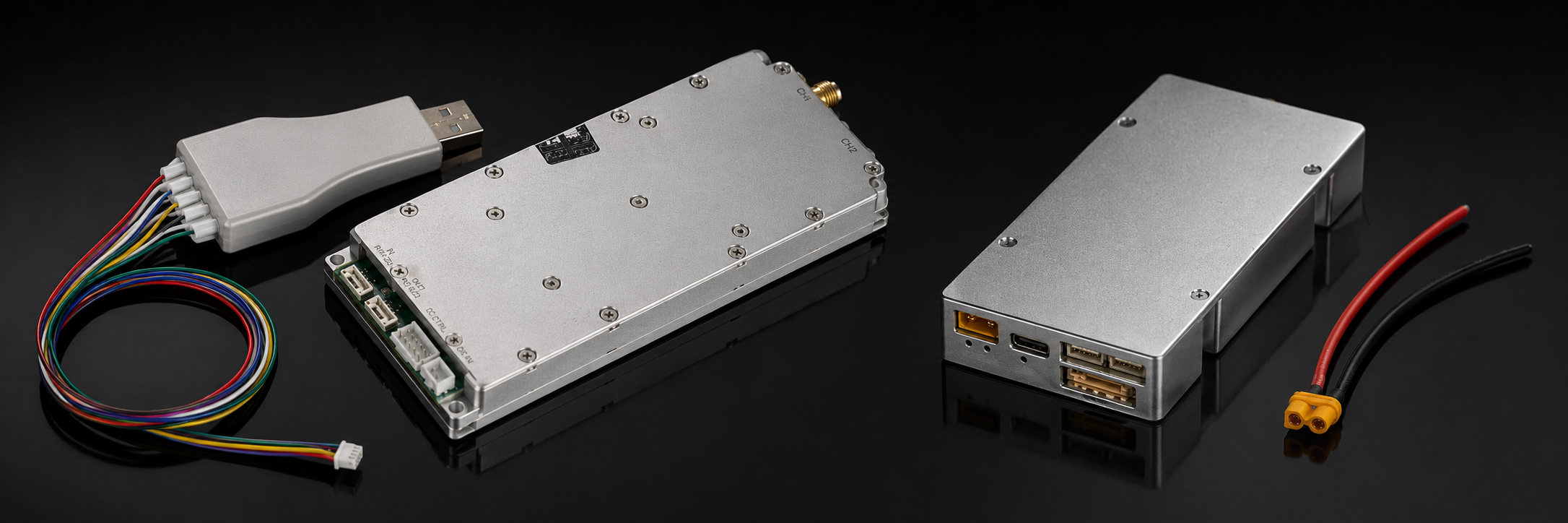
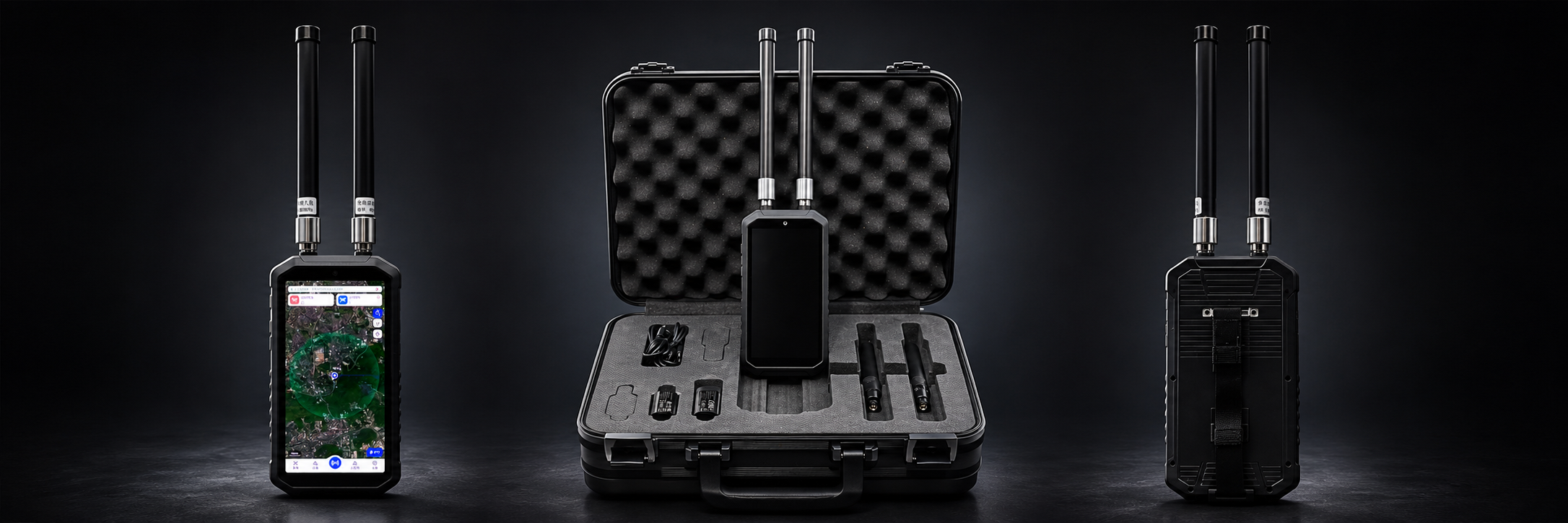


A drone jammer is a counter-drone mitigation device designed to disrupt the wireless links that a drone depends on for control, video, telemetry, or navigation support. In a professional C-UAS system, however, the real question is not only what a drone jammer does, but whether the full RF chain behind it can work safely, repeatedly, and under controlled deployment conditions.
Many readers first think of a drone jammer as a handheld device or a visible box with antennas. For system integrators, security contractors, airport teams, and critical infrastructure operators, that view is too simple. A professional drone jammer system depends on RF power amplifier modules, antenna matching, power supply stability, thermal design, control logic, protection behavior, and test evidence.
This article explains what a drone jammer is, how it works at a system level, what happens when a drone is jammed, what its limitations are, and how professional buyers should evaluate drone jammer module hardware for C-UAS integration.
1. What Is a Drone Jammer?
A drone jammer is a counter-drone device designed to interfere with communication or navigation-related links used by unmanned aerial systems. It is usually discussed as a mitigation layer, not as a complete C-UAS solution by itself.
Here’s the engineering point: in professional projects, the jammer is only one part of the system. You still need detection, classification, operator control, RF output hardware, antennas, power supply, thermal design, and event review.

What does a drone jammer try to affect?
A drone jammer normally targets the wireless dependency of the drone, not the physical drone body. The goal is to make the drone unable to receive or maintain a stable link under authorized and controlled conditions.
Common link categories include:
- Remote-control communication
- Telemetry feedback
- Video transmission
- Navigation-related reference signals
- Command or status exchange between drone and controller
Key Takeaway: A drone jammer should be understood as RF mitigation hardware inside a larger security system, not as a standalone magic button.
| Evaluation Point | Why It Matters |
|---|---|
| RF output path | Determines whether the mitigation signal is stable |
| Antenna system | Controls direction, coverage, and field behavior |
| Control logic | Defines when and how mitigation is activated |
| Test evidence | Shows whether performance can be repeated |
A professional buyer should ask what sits behind the jammer label before judging performance.
2. How Does a Drone Jammer Work?
A drone jammer works by creating controlled RF interference against wireless links that the drone depends on. The drone jammer does not “hack” the drone; it affects the signal environment around the drone’s control, video, telemetry, or navigation-related links.
The practical risk is clear: if the RF output is unstable, poorly matched, overheated, or uncontrolled, the system may not behave predictably. That is why professional jamming depends on hardware quality, not only on the concept of interference.
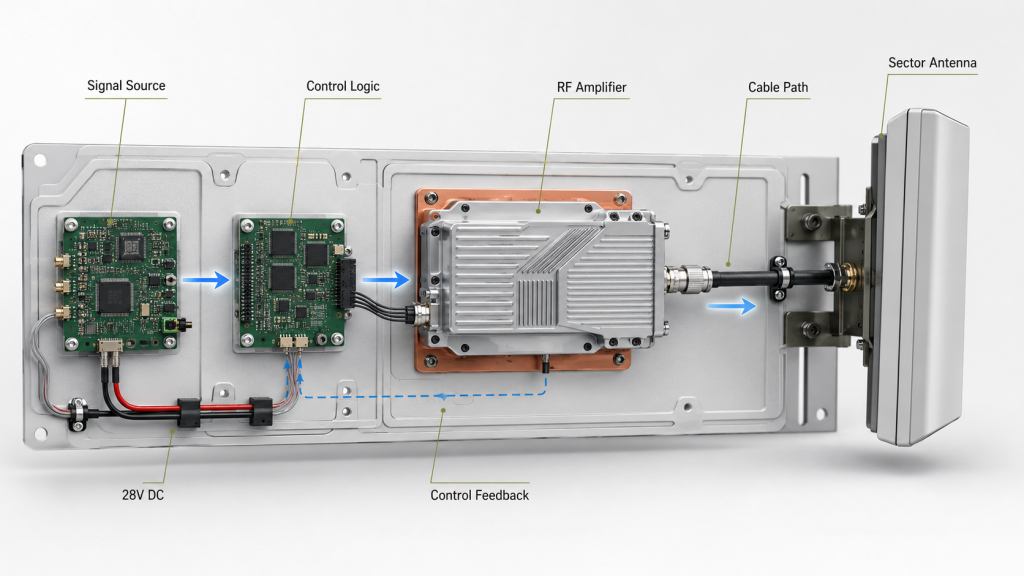
What happens inside the RF chain?
A professional drone jammer system usually starts with a signal source, control logic, RF amplification, filtering or routing, feeder cables, and antennas. Each part must be matched to the intended C-UAS mission.
A typical RF chain may include:
- Signal source or waveform control
- RF power amplifier module
- Power supply and current capacity
- Cable and connector path
- Directional or sector antenna
- Monitoring and protection feedback
Key Takeaway: A drone jammer works through RF disruption, but stable system behavior depends on the complete RF chain.
| RF Chain Part | Engineering Role |
|---|---|
| Signal source | Defines the mitigation signal type |
| RF amplifier | Raises RF output to usable level |
| Cable path | Transfers output with controlled loss |
| Antenna | Shapes coverage and direction |
| Control system | Coordinates activation and monitoring |
The jammer function is only as reliable as the hardware chain that delivers it.
3. What Happens When a Drone Is Jammed?
When a drone is jammed, its response depends on its flight-control logic, link dependency, firmware setting, mission mode, battery state, and navigation capability. A drone jammer may cause one drone to hover, another to return home, and another to continue a pre-set route.
Here’s the field reality: jamming does not guarantee one fixed result. That is why professional low-altitude security and C-UAS integration must combine mitigation with detection, confirmation, operator judgment, and event validation.
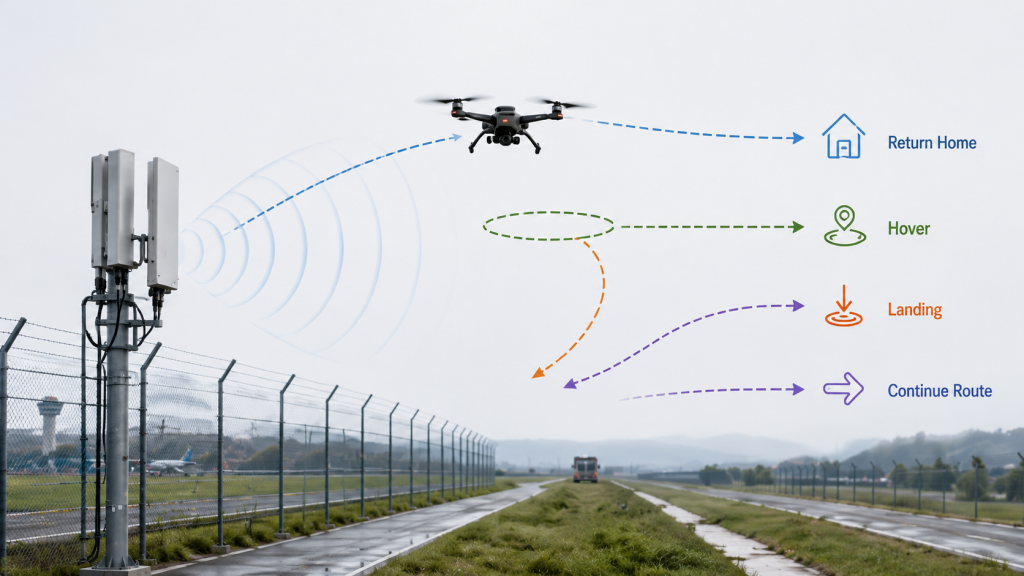
What responses are commonly expected?
Different drones react differently when their wireless links become unreliable. A professional system should plan for multiple outcomes rather than assuming one simple behavior.
Possible responses include:
- Return-to-home behavior
- Short-term hover
- Automatic landing
- Continued autonomous flight
- Unpredictable movement under poor conditions
Key Takeaway: Drone jamming creates link disruption, but the drone’s own logic decides the final behavior.
| Drone Response | What It Means for C-UAS Planning |
|---|---|
| Return home | May move the drone away from the protected zone |
| Hover | Requires continued monitoring |
| Landing | May create ground safety concerns |
| Continue mission | Shows the limit of link-based mitigation |
| Unpredictable behavior | Requires controlled engagement rules |
Professional C-UAS planning should assume variable outcomes, not a guaranteed single result.
4. What Are the Main Types of Drone Jamming?
The main types of drone jamming are usually grouped by the link they try to affect, such as control, video, telemetry, or navigation-related references. A drone jammer may also differ by output direction, installation type, and integration level.
This is where system integrators should pay attention: two systems may both be called drone jammers, but their internal RF architecture can be very different. A fixed-site airport system, vehicle-mounted system, and temporary event system do not have the same engineering requirements.

How do jamming types differ in hardware design?
Different jamming approaches place different pressure on frequency coverage, RF output stability, antenna layout, power supply, cooling, and protection behavior.
Important comparison points include:
- Control-link disruption
- Navigation-related disruption
- Video-link disruption
- Directional output
- Omnidirectional output
- Fixed-site integration
- Vehicle-mounted integration
Key Takeaway: Drone jamming type affects module selection, antenna design, thermal planning, and control logic.
| Jamming Type | Main Engineering Concern |
|---|---|
| Control-link focused | Link dependency and target behavior |
| Navigation-related | Legal and safety control |
| Video-link focused | Operator visibility disruption |
| Directional output | Controlled coverage direction |
| Omnidirectional output | Wider area but higher boundary risk |
A professional system should match the jamming method to the mission scenario, not select hardware by label alone.
5. What Are the Limitations of Drone Jammers?
Drone jammers have real limitations because drone behavior, signal environment, legal control, antenna placement, hardware stability, and autonomous flight capability all affect the result. A drone jammer is useful only when it is integrated and operated within an authorized system plan.
The practical risk is clear: a jammer that looks strong on paper may perform poorly if the drone is autonomous, the RF environment is complex, the antenna path is mismatched, or the amplifier overheats during long-duty operation.
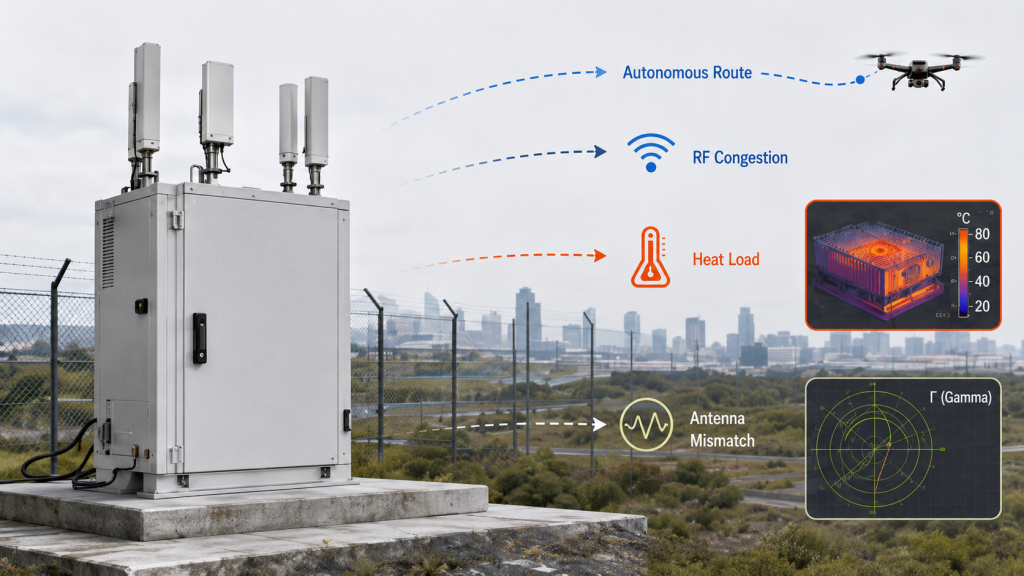
What limits should buyers check first?
Professional buyers should not treat limitations as a weakness in the concept. They should treat them as engineering conditions that must be reviewed before system approval.
Key limitations include:
- Autonomous drone behavior
- Anti-interference design
- Crowded RF environments
- Antenna direction and mounting
- Reflected power risk
- Thermal stress
- Local legal restrictions
Key Takeaway: Drone jammer performance is scenario-dependent, so professional evaluation must include field conditions and hardware stability.
| Limitation | Why It Matters |
|---|---|
| Autonomous flight | Drone may not rely on live control |
| RF congestion | Background signals affect planning |
| Heat buildup | Output may drop or protection may trigger |
| Antenna mismatch | Reflected power can damage or limit output |
| Legal restriction | Unauthorized use may be prohibited |
Limitations do not make drone jammers useless; they make professional integration necessary.
6. Are Drone Jammers Legal?
Drone jammer legality depends on local regulations, authorization status, deployment scenario, and RF control rules. A drone jammer should only be discussed in the context of lawful, authorized, and controlled C-UAS applications.
Here’s the safe engineering position: this article explains system concepts for professional security planning, not personal use or unauthorized deployment. Many countries restrict radio interference devices, so buyers must confirm local legal requirements before procurement or use.

Who normally evaluates legal deployment?
Professional drone jammer systems are usually evaluated by authorized organizations, government-related users, defense teams, law enforcement agencies, airport operators, or critical infrastructure security teams.
Legal review may involve:
- Local communications authority rules
- Site-specific deployment approval
- Safety and risk assessment
- Operator authorization
- RF boundary control
- Event logging and accountability
Key Takeaway: Drone jammer legality is not a product feature; it is a deployment condition that must be confirmed before use.
| Legal Factor | Practical Meaning |
|---|---|
| Jurisdiction | Rules differ by country and region |
| User authorization | Personal use may be prohibited |
| Site approval | Sensitive areas need careful review |
| RF boundary | Non-target systems must be protected |
| Documentation | Records support accountable operation |
A compliant C-UAS project should start with authorization, not with hardware activation.
7. Drone Jammer vs. Drone Spoofer: What Is the Difference?
A drone jammer disrupts wireless links, while a drone spoofer attempts to mislead navigation or reference signals. A drone jammer is usually disruption-based, while spoofing is deception-based.
This is where the distinction matters: both methods have legal, safety, and technical constraints, and neither should be treated as a complete C-UAS solution by itself. Professional systems still need detection, tracking, control, mitigation selection, and post-event review.

How should buyers compare them?
Buyers should compare jamming and spoofing at the concept level without assuming one is always better. The right approach depends on the legal environment, target behavior, system architecture, and authorized operating scenario.
Useful comparison points include:
- Link disruption versus signal deception
- RF output hardware versus navigation manipulation
- System control requirements
- Legal approval burden
- Safety and predictability
- Integration with detection and tracking
Key Takeaway: Jamming and spoofing are different mitigation concepts, but professional C-UAS performance depends on system design rather than one method name.
| Method | Basic Concept | Key Concern |
|---|---|---|
| Drone jammer | Disrupts wireless links | RF output control |
| Drone spoofer | Misleads reference signals | Legal and safety control |
| Combined system | Uses layered mitigation | Higher integration burden |
| Detection-only system | Identifies and tracks threats | No direct mitigation |
The correct question is not which term sounds stronger, but which approach can be legally controlled and technically verified.
8. What Makes a Professional Drone Jammer System Different?
A professional drone jammer system is different because it depends on engineered RF modules, stable amplifier output, antenna integration, thermal control, protection logic, and repeatable test evidence. A drone jammer should not be judged only by its outer housing, antenna count, or advertised range.
Here’s the engineering point: professional buyers need to look inside the system. The RF power amplifier module inside a drone jammer system plays a major role in output stability, thermal behavior, protection response, and repeatable C-UAS integration.

What should professional evaluation include?
A professional jammer system should be evaluated as a controlled RF platform. The quality of the internal architecture often matters more than the visual appearance of the finished device.
Key review areas include:
- Frequency coverage
- Full-band output stability
- RF power amplifier quality
- Thermal path
- VSWR protection
- Voltage protection
- Control interface
- Test report detail
Key Takeaway: A professional drone jammer system is defined by verified RF engineering, not by appearance.
| Professional Factor | What Buyers Should Ask |
|---|---|
| Frequency coverage | Does it match the mission bands? |
| Output stability | Is power stable across the band? |
| Thermal design | Can it handle real duty cycle? |
| Protection logic | What happens under abnormal load? |
| Test evidence | Can the result be repeated? |
A professional system should be measured, documented, and reviewed before field use.
9. Why Does the Drone Jammer Module Matter?
The RF power amplifier module matters because it turns the drone jammer concept into stable, controllable, and testable RF output. Without a reliable amplifier stage, a drone jammer may have weak output, unstable heat behavior, protection alarms, or inconsistent field performance.
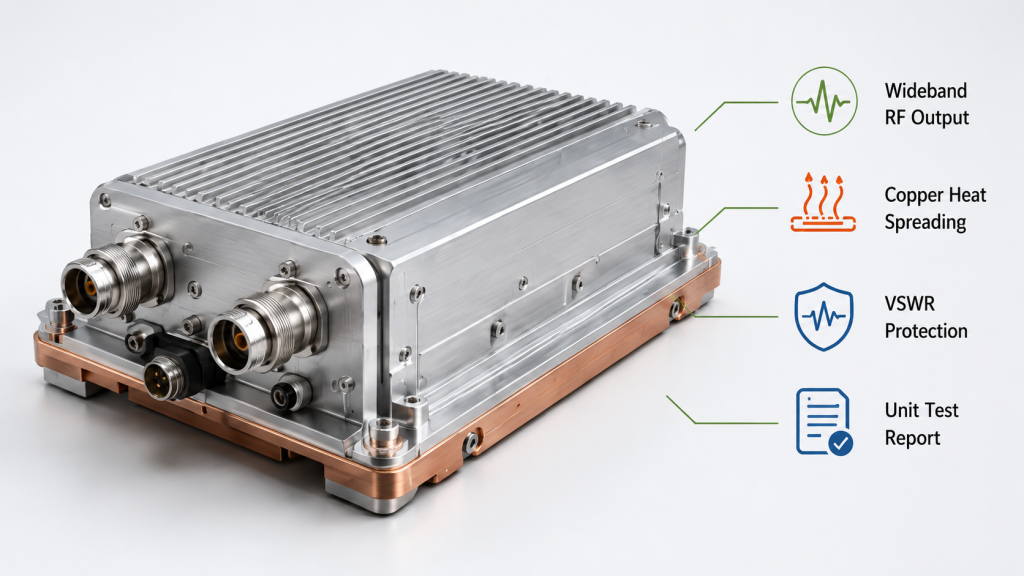
This is where hardware quality becomes visible. Professional RF power amplifier module design may include wideband RF output, CNC housing, copper heat spreading, VSWR protection, temperature protection, voltage protection, and unit-level test reports for C-UAS integration.
What does the amplifier decide?
The amplifier affects more than peak wattage. It influences whether the system can maintain usable RF output under real voltage, thermal, load, and duty-cycle conditions.
The amplifier helps define:
- Output power behavior
- Efficiency and heat load
- Full-band consistency
- Long-duty stability
- Reflected power response
- Module protection behavior
- Acceptance-test repeatability
Key Takeaway: The RF power amplifier module is one of the core reasons a professional jammer system can remain stable under real C-UAS conditions.
| Amplifier Factor | System Impact |
|---|---|
| Output power | Affects usable RF energy |
| Gain stability | Supports full-band consistency |
| Thermal design | Protects long-duty operation |
| VSWR protection | Reduces mismatch risk |
| Test report | Supports buyer verification |
A drone jammer system should not be approved only by peak-power claims; amplifier behavior must be verified.
10. How Should You Evaluate a Drone Jammer Module?
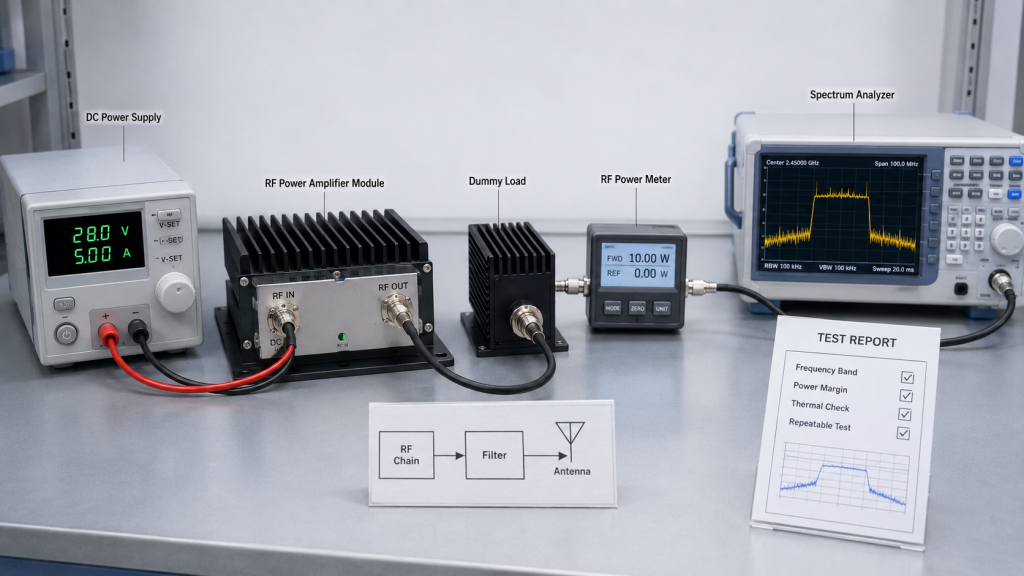
You should evaluate a drone jammer module by checking frequency coverage, RF output stability, amplifier quality, duty cycle, thermal path, protection logic, control interface, antenna path, and repeatable test evidence. A drone jammer module is not just a part number; it is a hardware block inside a complete C-UAS RF chain.
This is where procurement and engineering should work together. Before approving a project, system integrators should start by choosing the correct RF power amplifier frequency range for the mission, then review power, heat, control, and test conditions together.
What should be on the buyer checklist?
A useful checklist should connect datasheet values with real deployment conditions. You are not only asking whether the module can transmit; you are asking whether it can remain stable inside your system.
Review items should include:
- Frequency band
- Output power and margin
- RF amplifier structure
- Duty cycle
- Cooling method
- VSWR behavior
- Voltage tolerance
- Control interface
- Antenna and feeder path
- Test-report format
Key Takeaway: A drone jammer module should be approved through system-level engineering checks, not only through wattage or frequency labels.
| Buyer Check | Why It Matters |
|---|---|
| Frequency band | Prevents mission coverage gaps |
| Power margin | Reduces late output surprises |
| Duty cycle | Separates short test from real use |
| Thermal path | Protects full-load operation |
| Test report | Confirms repeatable evidence |
A good RFQ should describe the operating scenario, not just ask for a jammer price.
FAQ
Can I use a drone jammer for personal drone problems?
No, you should not assume personal use is legal. Drone jammers are restricted in many regions because they intentionally affect radio signals, so they should only be considered for authorized C-UAS security applications.
What’s the best drone jammer type for C-UAS projects?
The best type depends on the mission scenario. Fixed-site, vehicle-mounted, airport, border, prison, and temporary event systems all have different requirements for coverage, control, antenna layout, duty cycle, and legal approval.
How do I know if a drone jammer module is reliable?
You know by checking test evidence, not only datasheet claims. Ask for frequency-point data, RF output, voltage, current, temperature, load condition, VSWR behavior, protection status, and repeatable test conditions.
Can a drone jammer stop every drone?
No, no jammer should be treated as a guaranteed answer for every drone. Autonomous flight, pre-set routes, anti-interference design, site conditions, and legal limits can all affect the result.
What’s the difference between a drone jammer and a full C-UAS system?
A drone jammer is a mitigation component, while a full C-UAS system includes detection, classification, tracking, control, mitigation, antenna planning, logging, and operator workflow.
Conclusion
A drone jammer is best understood as a controlled RF mitigation component inside a professional counter-drone system. It may disrupt control, video, telemetry, or navigation-related links, but its real performance depends on the RF chain behind it: amplifier stability, frequency coverage, antenna matching, thermal design, power supply stability, protection logic, and repeatable test evidence.
For system integrators and professional buyers, the practical question is not only “what is a drone jammer?” The better question is whether the drone jammer module, RF power amplifier module, antenna layout, control interface, cooling method, and test report can support your real C-UAS deployment scenario.
RF SKYPOWER can support professional C-UAS projects with drone jammer module hardware, RF power amplifier modules, wideband RF modules, CNC housings, copper heat spreading, VSWR / temperature / voltage protection, and source-factory test evidence. If your project needs engineering review before module selection, you can discuss frequency coverage, output power, duty cycle, thermal condition, control logic, and test-report requirements with a source-factory engineering team.
Professional C-UAS mitigation should be controlled, measurable, and built from reliable RF core components.